
Market order vs limit order: speed or price?
Every order answers one question: speed or price? A market order picks speed. A limit order picks price, and knowing which you need saves surprises.
The short answer
A Market order says, "Fill me now, at the best price available." It almost always fills, but the exact price isn't promised.
A Limit order says, "Fill me only at this price or better." You control the price, but the order may never fill.
Side by side
| Market order | Limit order | |
|---|---|---|
| What you set | Only the size | The size and your price |
| Does it fill? | Almost always, right away | Only if price reaches your level |
| Price you get | The best available now, may be worse than you saw | Your price or better |
| Risk of slippage | Yes, more in fast or thin markets | No slippage past your price |
| Risk of missing the trade | Very low | Yes, price may never come back |
| Best for | Getting out fast, busy markets | Planned entries at a level, targets |
| Cost of the spread | You pay it | You may avoid part of it |
Market orders: speed first
When you hit buy at market, you get the sellers' asking price at that moment. See Bid and ask. In a busy market like a large stock, that's usually within a cent of what you saw.
When it helps:
- Getting out. If your plan says exit now, speed matters more than a cent.
- Busy markets. Big stocks, main forex pairs and index futures usually fill close to the screen price.
When it hurts:
- Fast news moments. Around a rate decision or jobs report, the price can jump between your click and the fill.
- Thin markets. Small stocks or quiet hours can fill you far from the last price.
- Open and close. The first minutes after 9:30 am ET can have wide spreads.
Limit orders: price first
A buy limit sits below the current price and waits for price to come down to it. A sell limit sits above the current price and waits for price to rise to it.
When it helps:
- Entering at a level. You've marked a zone where price turned before. A limit order waits there for you. See support and resistance.
- Setting a target. Your Take profit is usually a limit order.
- Staying calm. The plan is placed ahead of time, so you're not clicking in the heat of the moment.
When it hurts:
- Missed trades. Price can stop one tick short and run away without you.
- Partial fills. Sometimes only part of your order fills.
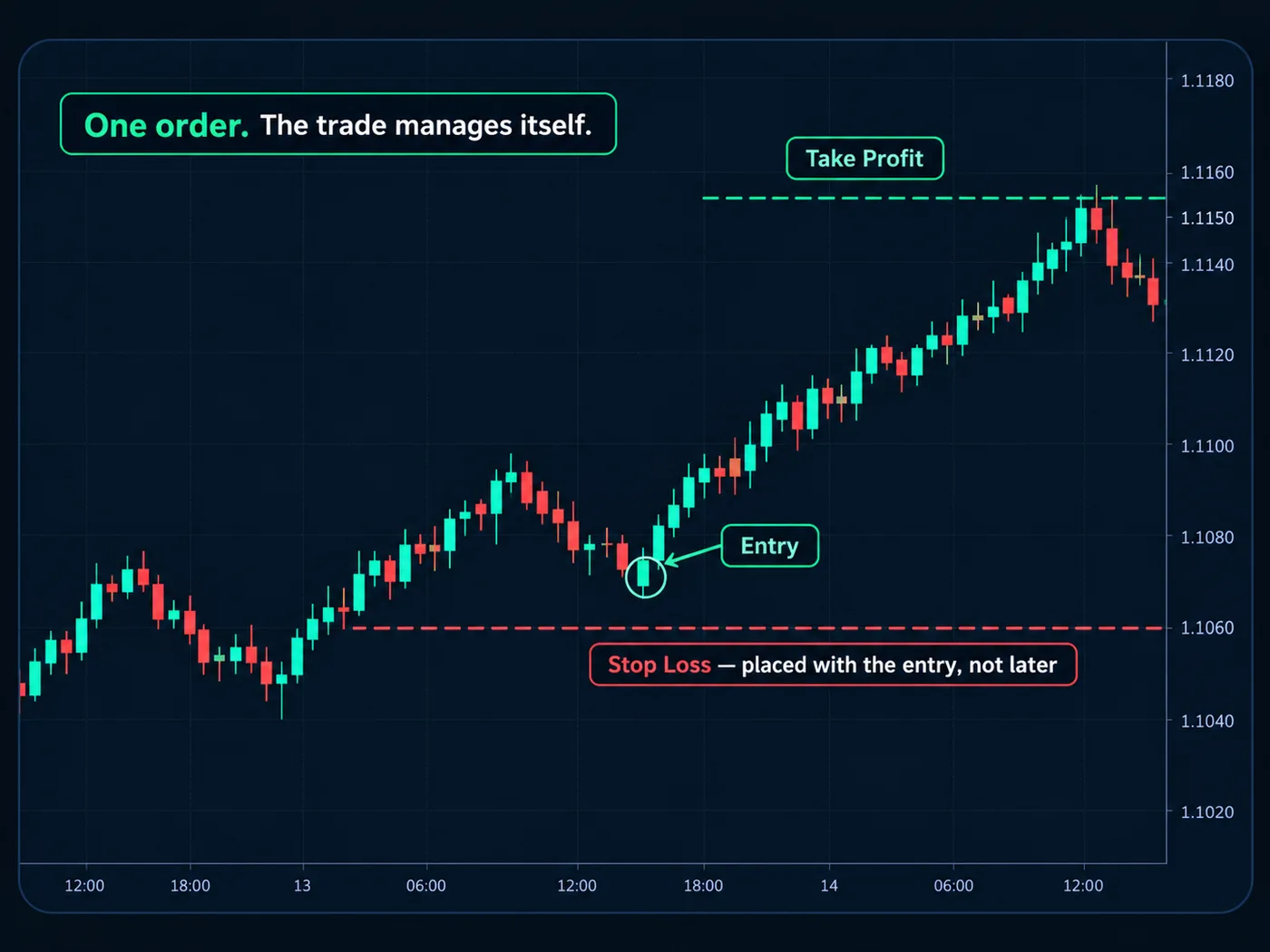
Plan the whole trade at once. Many traders place the entry, the stop and the target together, as a bracket. Then the risk is set before anything happens. The risk-reward calculator checks the plan first.
Which fits you?
This isn't a choice you make once. Most traders use both:
- Limit orders for planned entries and targets, when you know your level ahead of time.
- Market orders to get out when your plan says the trade is over.
- A stop order for your exit if wrong. That's a third type. See stop loss vs stop-limit.
If you trade fast markets around news, expect market orders to slip more. If you trade quiet hours, check the spread first.
Common mistakes
- Using market orders in thin stocks. The fill can be far from the price on screen.
- Moving a limit order to chase price. If price left without you, the setup is gone. Let it go. See FOMO trading.
- Placing a buy limit above the price. It fills right away, like a market order, often by mistake.
- No stop after a limit fills. A filled entry still needs its stop.
Questions
Is a limit order better than a market order?
Neither is always better. A limit order controls your price but may not fill. A market order fills fast but the price can slip. Many traders enter with limits and exit with market or stop orders.
Why didn't my limit order fill?
Price never reached your level, or it touched it but there weren't enough orders on the other side. A limit only fills at your price or better.
What is slippage?
Slippage is the gap between the price you expected and the price you got. It happens most with market and stop orders in fast or quiet markets.
Should I use a market order at the market open?
Be careful. Spreads can be wide and prices jump in the first minutes after 9:30 am ET. Many beginners wait for things to settle or use limit orders.
Want the next step? We'll walk you through it.
Four free lessons by email, one every few days — each with a 10-minute exercise on a real chart.
Send Me the Free Lessons 4 short emails · No spam · Unsubscribe anytimeOr see the whole method, step by step:
See What’s Inside the Course Try everything free first. Decide when you're ready. · Open the free chart tool (works in the TradingView phone app)One chart idea a day, in plain English. Follow along: