
How to set a stop loss: decide your exit before you enter
A stop loss is the exit you pick while you're still calm. It answers one question before the trade starts: "Where am I clearly wrong?"
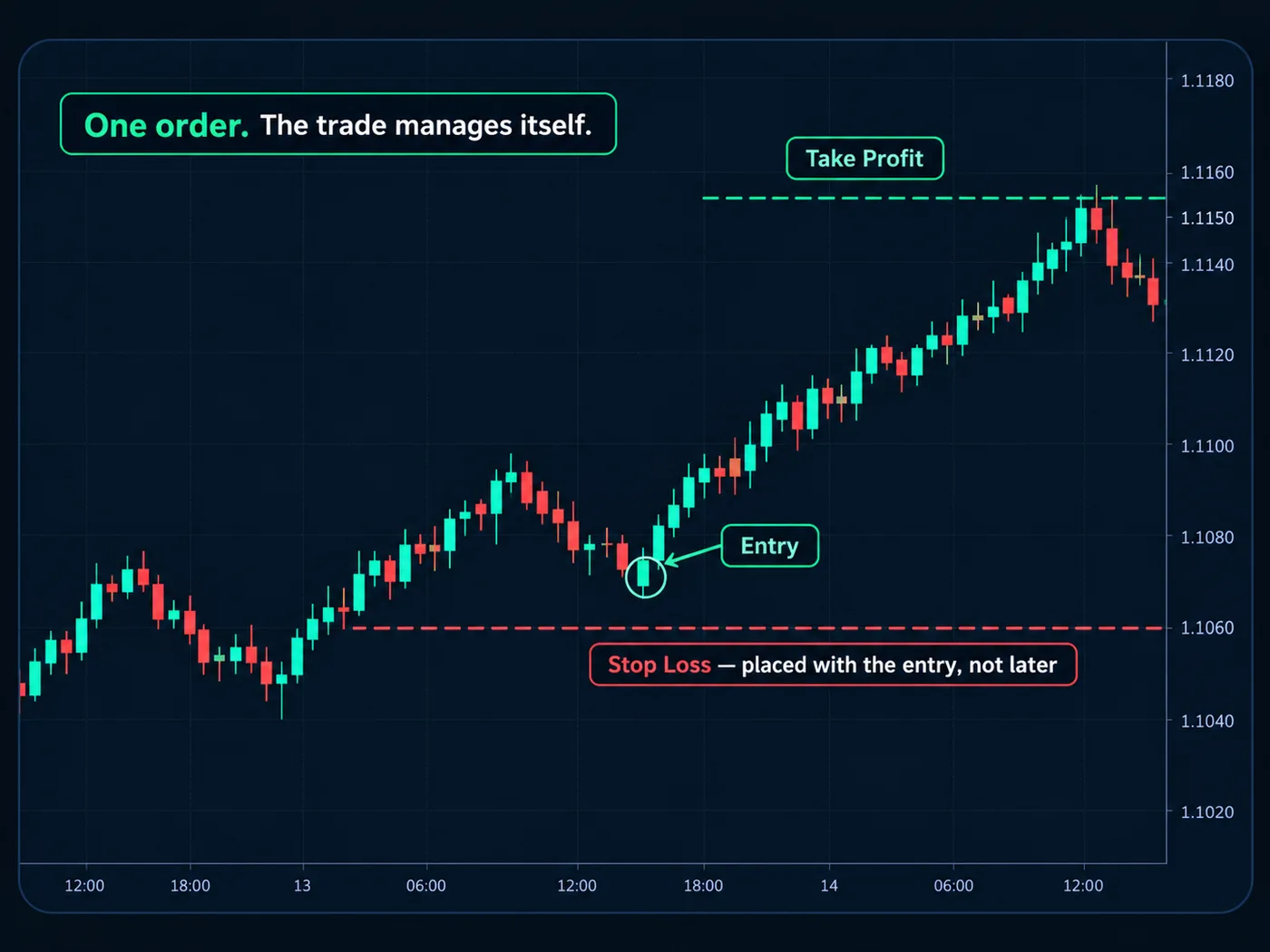
What a stop loss does
A stop loss is an order that gets you out of a trade if price moves against you to a price you picked. It caps how much one trade can cost.
Think of it as a seat belt. You put it on before you drive, not when you see the crash coming.
The rule: set it before you enter
The stop is part of the trade, not something you add later. You decide it first, then you work out your size from it, then you enter.
Why before? Because once you're in a trade, every tick feels personal. It's hard to think clearly while the number on screen is moving. Decide while nothing is at stake yet.
The order of steps: 1) find where the trade idea is wrong, 2) put the stop just past that place, 3) work out your size from the distance, 4) only then enter.
Where to put it: just past the turning point your idea depends on
Every trade idea leans on something on the chart. Usually that's the last place price turned around.
- Buying (going long): you're betting the last low holds. Put the stop just below that low.
- Selling (going short): you're betting the last high holds. Put the stop just above that high.
If price breaks past that turning point, your idea is simply wrong. There's no reason to stay. That's why it makes a good stop: it's the place the chart itself says "not this time."
Want the plain-English version of those turning points? See higher highs and higher lows.
Why "just past" and not right on it
Price often pokes a little through a level and snaps back. Those pokes are wicks — the thin lines above and below a candle body. A stop placed exactly on the low gets hit by a poke that means nothing.
Give it a small cushion. A few cents on a stock, a few pips in forex, a tick or two in futures. The cushion should be small and the same every time, so you're not guessing.
Bad places for a stop
- A round number of dollars you picked. "I'll risk $50" is a size decision, not a stop. The chart doesn't know your budget.
- Right on a level. Easy for a meaningless wick to hit.
- Somewhere random because it "feels close." A stop with no chart reason gets hit for no reason.
- No stop at all. "I'll watch it" is not a plan. Screens freeze, phones die, and people freeze too.
The stop sets your size, not the other way round
Once the stop is set from the chart, the distance tells you how big the trade can be.
Example (an illustration): you risk $20 on a trade. Your entry is $50.00. The last low is $49.10, so your stop goes at $49.00 — $1.00 away. $20 ÷ $1.00 = 20 shares. If the stop is hit, you lose about $20.
A wide stop means a small trade. A tight stop means a bigger one. The money at risk stays the same. Our position size calculator does the math, and how much to risk per trade explains the 1% rule behind it.
Never move it further away
This is the one rule that matters most. You can move a stop closer to lock in a gain once the trade has moved well in your favour. You never move it further away to "give it room."
Moving it away feels like hope. In practice it turns a small, planned loss into a big, unplanned one. If the chart says you're wrong, the trade is over. The next trade is a fresh start.
Make it automatic. Place the stop as a real order with the broker the moment you enter. A stop that lives only in your head is easy to argue with.
Stop orders vs stop-limit orders
Brokers offer two main kinds of stop. They behave very differently when price moves fast.
| Stop order | Stop-limit order | |
|---|---|---|
| What happens at your price | Becomes a market order: sell (or buy) now | Becomes a limit order: only at your price or better |
| Will it fill? | Yes, almost always | Not always |
| Will the price be exact? | Not always | Yes, if it fills |
| Main risk | A worse price in a fast move | Not getting out at all |
A stop order makes sure you get out, even if the price is a bit worse than planned. A stop-limit protects the price but can leave you stuck in the trade if price jumps past your limit.
For a protective stop, most beginners are better served by a plain stop order: getting out matters more than the exact price. The full comparison is in stop loss vs stop limit.
Gaps and slippage: when the stop isn't exact
A stop is a promise to try, not a promise of the exact price.
- Slippage is the difference between your stop price and the price you actually got. In a fast market, the next available price may be a little worse.
- A gap is when price opens far from where it closed — often overnight or after big news. If a stock closes at $50 and opens at $47, a stop at $49 fills near $47, not $49.
So a trade sized to lose $20 can sometimes lose more. Ways to keep that small:
- Avoid holding through big scheduled news, like a company's earnings or a CPI or FOMC day.
- Be extra careful over weekends and overnight.
- Keep your risk per trade small, so even a bad fill is a bad day, not a disaster.
Common mistakes
- Setting the stop after entering. By then emotions are already in charge.
- Making the stop tighter just to buy more shares. Put it where the chart says, then size down.
- Moving it further away "just this once." That's the habit that causes the biggest losses.
- Using a stop-limit and assuming you're safe. In a fast move it may never fill.
Try it today
- Open any chart and find the last clear low price turned up from.
- Pretend you're buying now. Mark a stop just below that low.
- Measure the distance from now to the stop.
- Pick a practice risk, like $10, and divide it by that distance. That's your size.
Do this on five charts. It gets fast. Our free chart tool on TradingView marks those turning points for you, so finding the stop takes seconds: add the StructureX indicator.
Questions
What is a good stop loss percentage?
There isn't one good percentage. A fixed percent ignores the chart. Put the stop just past the turning point your idea depends on, then size the trade so hitting it costs about 1% of your account.
Should I use a stop loss on every trade?
Yes. Without one, there's no limit on what a single trade can cost. Set it before you enter and place it as a real order with your broker.
Can I move my stop loss?
You can move it closer to protect a gain once price has moved well your way. Never move it further away. That turns a small planned loss into a large one.
Why did my stop fill at a worse price?
That's slippage, or a gap. A stop order becomes a market order when it's touched, so in a fast move or after a gap it fills at the next available price.
Is a mental stop loss OK?
It's risky while you're learning. It's easy to talk yourself out of a stop that only exists in your head. A real order with the broker removes that choice.
Want the next step? We'll walk you through it.
Four free lessons by email, one every few days — each with a 10-minute exercise on a real chart.
Send Me the Free Lessons 4 short emails · No spam · Unsubscribe anytimeOr see the whole method, step by step:
See What’s Inside the Course Try everything free first. Decide when you're ready. · Open the free chart tool (works in the TradingView phone app)One chart idea a day, in plain English. Follow along: