
What is a stop loss in trading?
In one line: A stop loss is an order you set in advance that closes your trade at a chosen price if the market moves against you.
A simple example
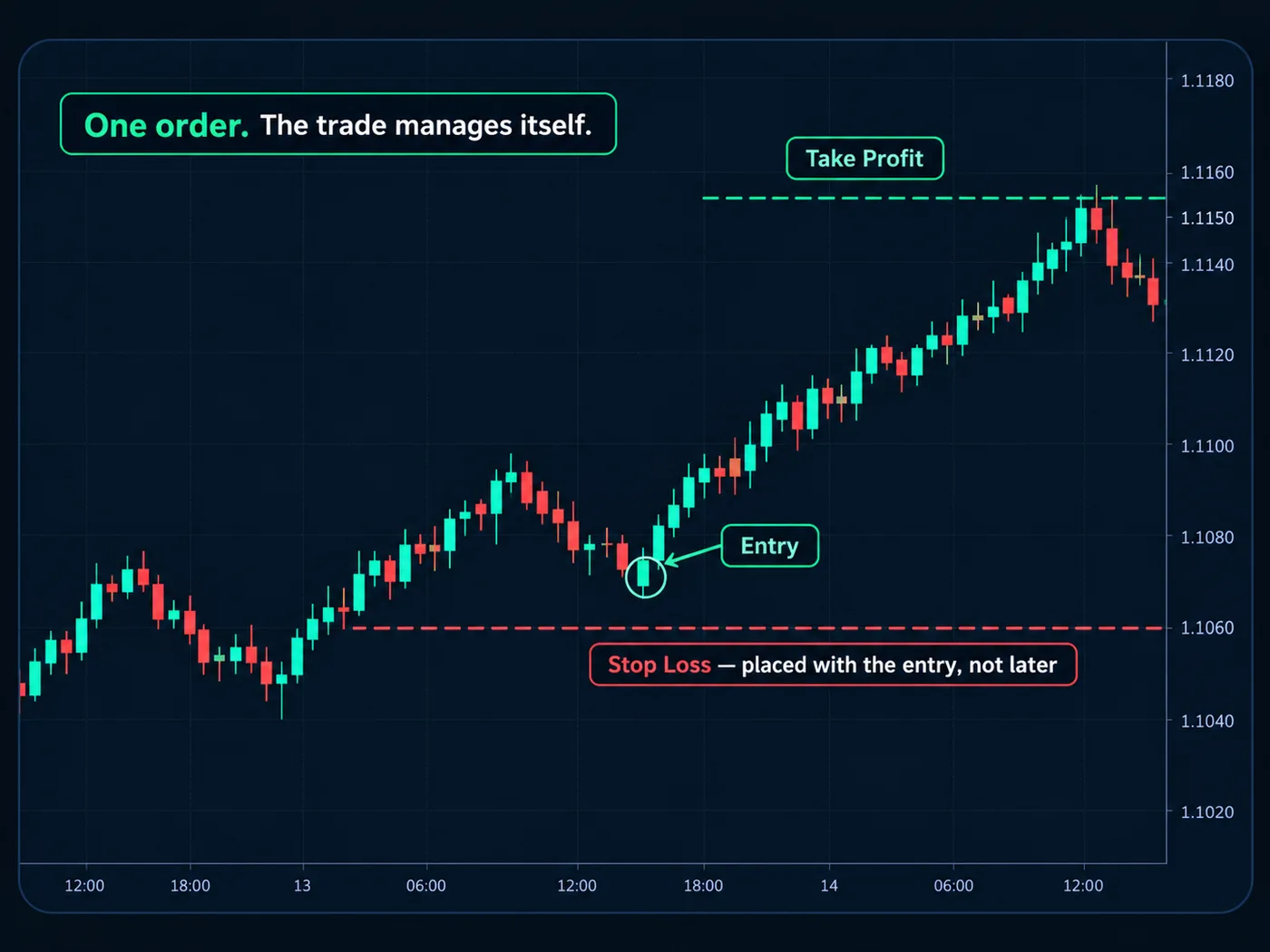
You buy a stock at $50. On the chart, the last place price turned back up is $48.80. If price falls below that, your idea was wrong.
So you place a stop loss at $48.60, a little under that turning point. If price drops there, your platform sells for you. You lose about $1.40 a share, an amount you knew before you got in.
Why it matters
A stop loss turns "how much could this cost?" into a number you pick. That number is what lets you size the trade. If you risk $20 and your stop is $1.40 away, you buy about 14 shares ($20 ÷ $1.40). The position size calculator does that math for you.
It also takes the decision away from the moment. When a trade goes against you, it's hard to think clearly. The stop already made the call.
A common mistake
Placing the stop where the money feels right instead of where the chart says you're wrong. A stop set at "$1 below, because that's what I can afford" often sits in the middle of normal price wiggles. It gets hit, and then price goes your way without you.
Put the stop past the level that proves the idea wrong. If that's too far for your budget, make the trade smaller or skip it. Never move the stop further away once the trade is live. The full method is in how to set a stop loss.
A stop loss is not a guarantee. In a fast market or over a Gap, price can jump past it, and you get filled worse. That's called Slippage.
Questions
Where should I put my stop loss?
Just past the last place price turned around against your idea: below it for a buy, above it for a sell. That's the point where the chart says your idea failed.
Should I move my stop loss?
You can move it in your favor to protect a trade, but never further away to avoid a loss. Widening a stop only makes the loss bigger.
Is a stop loss the same as a stop-limit order?
No. A stop loss becomes a market order and fills at the next price. A stop-limit won't fill past your limit, so it may not close you out at all. See stop loss vs stop limit.
Want the next step? We'll walk you through it.
Four free lessons by email, one every few days — each with a 10-minute exercise on a real chart.
Send Me the Free Lessons 4 short emails · No spam · Unsubscribe anytimeOr see the whole method, step by step:
See What’s Inside the Course Try everything free first. Decide when you're ready. · Open the free chart tool (works in the TradingView phone app)One chart idea a day, in plain English. Follow along: