
How much to risk per trade: the 1% rule, worked out
You've seen "risk 1%" everywhere. Here's what it means in real numbers, and why it's the first thing to decide, before where you get in.
Risk a small, fixed slice
Many traders risk about 1% of their account on any one trade. On a $1,000 practice account, that's $10. On a $10,000 account, $100.
Why so small? Because losing streaks happen to everyone. At 1%, ten losses in a row is a bad week, not the end. At 10% a trade, the same streak can wipe out most of an account — and the loss recovery calculator shows how hard that is to climb back from.
Your stop sets your size
Before you get in, decide where you'll get out if you're wrong. That exit is your stop loss. Then size the trade so hitting the stop costs exactly your 1% — no more.
The formula: trade size = money at risk ÷ distance to your stop. Example: you risk $10. Your stop is $0.50 below your entry. $10 ÷ $0.50 = 20 shares. If the stop is hit, you lose $10 — the amount you chose.
Notice what this means: a wider stop gives a smaller trade, and a tighter stop gives a bigger one. The money at risk stays the same. Our position size calculator does this math for you (forex: the lot size calculator).
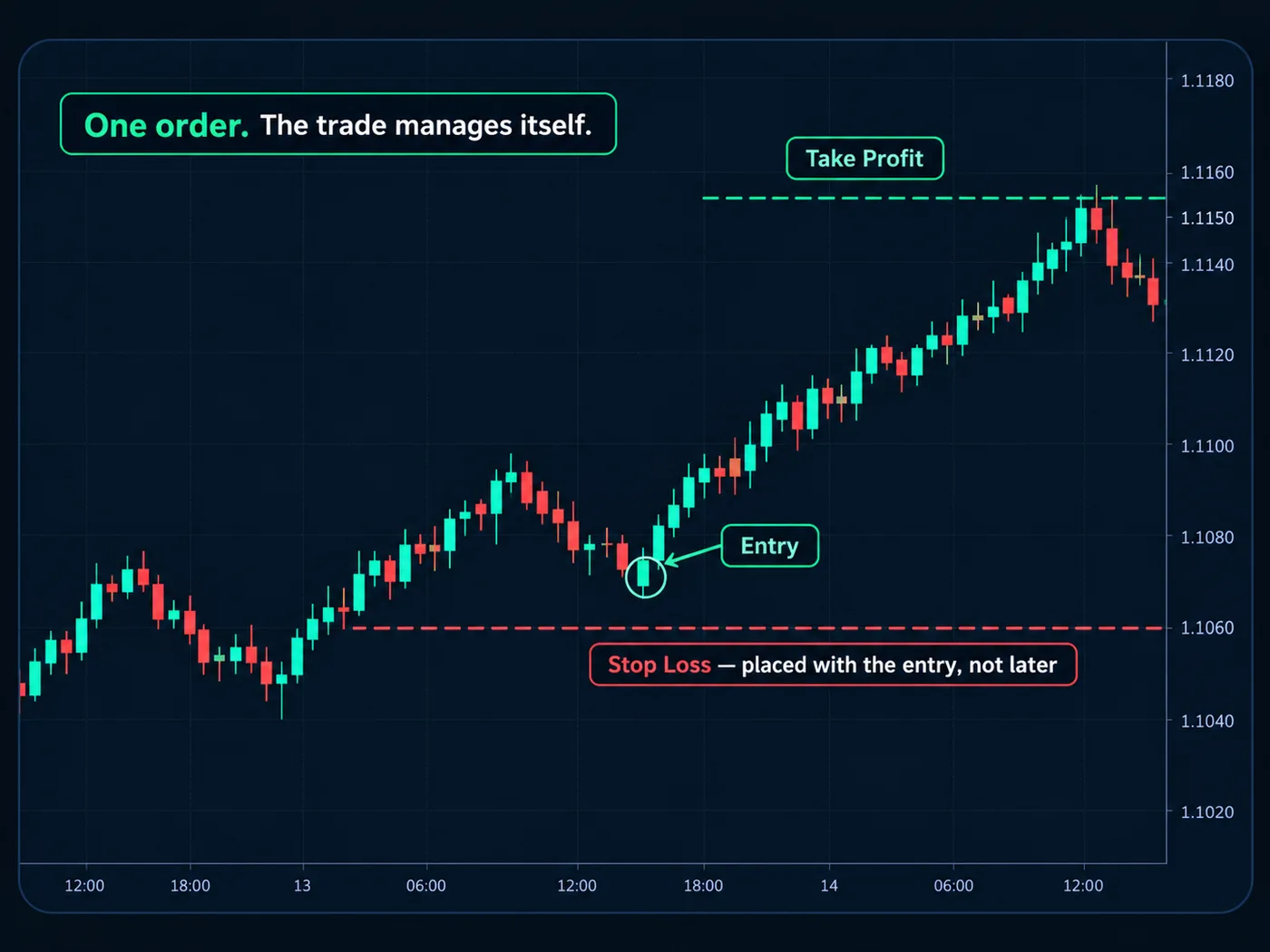
Aim to win at least twice what you risk
If you risk $10, aim for a target worth $20 or more. That's called a 2-to-1 trade. Here's why it matters:
See the math (in units of risk): over 10 trades, 4 wins at +2 and 6 losses at −1 adds up to +8 − 6 = +2 units — even though you lost more often than you won. That's a math example, not a promise. Real results vary — and depend on following the rules every time.
The 2-loss rule
Two losses in one day? You're done for the day. It sounds strict, but it keeps bad days small — and it stops the most expensive habit in trading: trying to “win it back” right away. More in why traders use a daily loss limit.
Try it today
- Write down your practice account size.
- Work out your 1% in dollars.
- Write your daily stop: two losses.
- Keep those three numbers next to your screen.
Questions
Is 1% per trade too small for a small account?
It feels small, and that's the point. A small account grows a skill first. Risking more doesn't make you better — it only makes each mistake cost more while you're still learning.
Should I risk the same amount on every trade?
Yes, while you're learning. A fixed amount keeps your results honest: you can compare trades fairly, and one bad trade can't undo ten good ones.
What if my stop needs to be very far away?
Then the trade gets smaller, or you skip it. Never move the stop closer just to fit a bigger size — put it where the chart says you're wrong.
Want the next step? We'll walk you through it.
Four free lessons by email, one every few days — each with a 10-minute exercise on a real chart.
Send Me the Free Lessons 4 short emails · No spam · Unsubscribe anytimeOr see the whole method, step by step:
See What’s Inside the Course Try everything free first. Decide when you're ready. · Open the free chart tool (works in the TradingView phone app)One chart idea a day, in plain English. Follow along: