
Daily loss limit: the 2-loss rule that keeps one bad day small
The first loss of the day is rarely the costly one. The trades right after it are, so pick your stop point before the day starts, while you're calm.
What a daily loss limit is
A daily loss limit is the point where you stop trading for the day, no matter what. You pick it before the market opens, while you're calm.
When you hit it, you close the platform. Not "one more trade." Done until tomorrow.
The 2-loss rule
The simplest version: two losing trades in a day, and you're finished for the day.
If you risk 1% a trade, the worst normal day costs about 2%. That's a day you can shrug off. Tomorrow you start fresh, with a clear head and almost all of your account.
Why count losses instead of dollars? Because it's easy to remember and easy to follow. You don't need to do math while upset. You just count to two.
The rule in one line: two losses, platform closed, back tomorrow.
Why stopping protects you
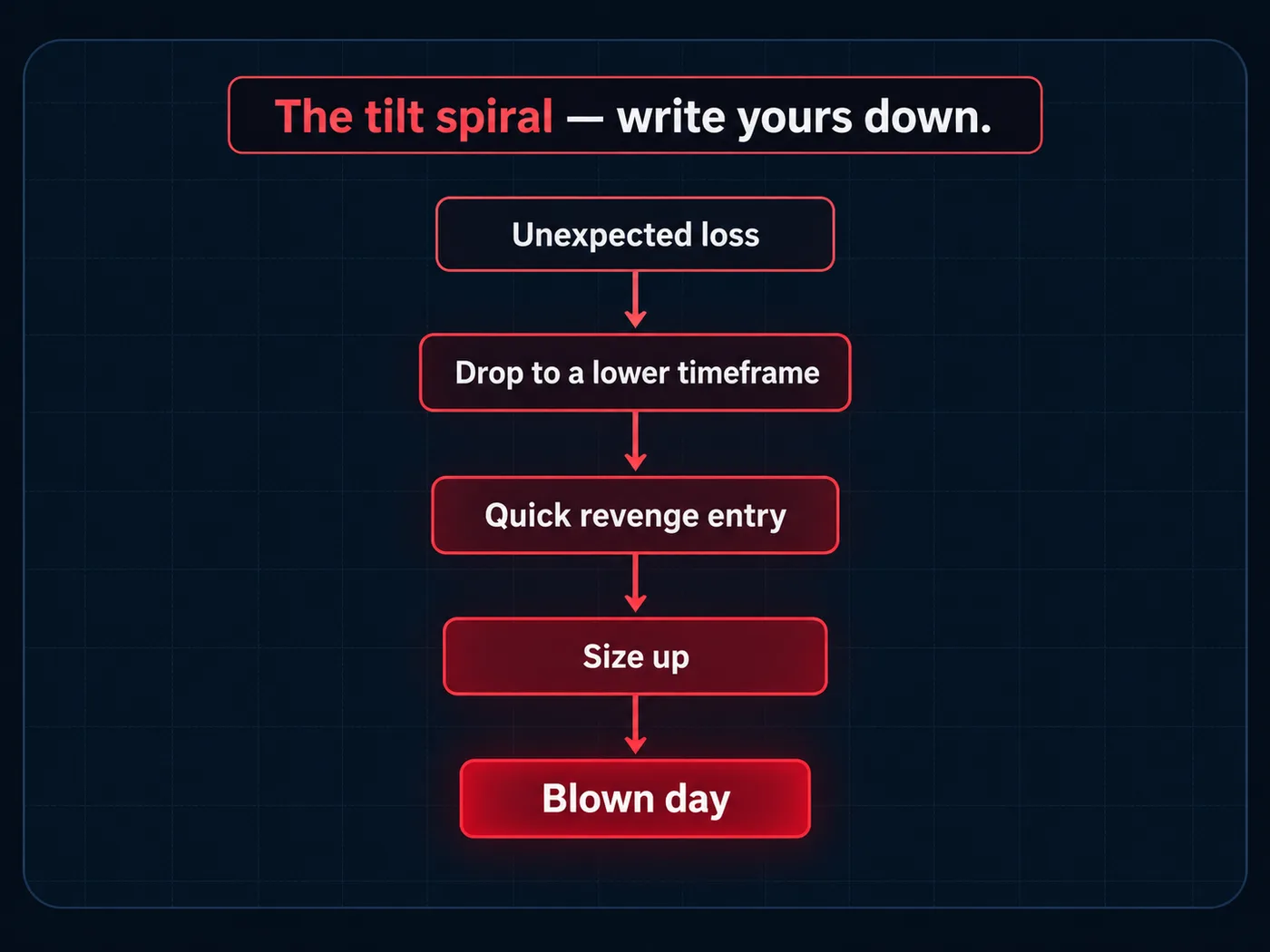
After a loss, most people feel a pull to "win it back." That pull is normal. It's also the start of the most expensive pattern in trading:
- A loss stings.
- The next trade gets taken faster, with less checking.
- It's often bigger, "to make up for it."
- If that loses too, the pressure doubles.
That's sometimes called revenge trading. The daily limit doesn't ask you to fight that feeling. It just removes the chance to act on it.
There's a quieter reason too. Two losses in a row can mean the market isn't behaving like your setup expects today. Stepping away is often the smartest read of the day.
Add a weekly limit
Some weeks bring several bad days in a row. A weekly limit caps those.
A common choice: stop for the week once you're down 5 units of risk (five full losses' worth). At 1% a trade, that's about 5% of the account.
When you hit it:
- Stop live trading until next week.
- Use the time to review your journal: were the losses good trades that didn't work, or rule breaks?
- Practice on past charts instead, where nothing is at risk.
The recovery math
Here's why keeping losses small matters so much. The deeper the hole, the bigger the gain needed just to get back to where you started.
| Account down | Gain needed to get back to even |
|---|---|
| 10% | 11.1% |
| 20% | 25% |
| 25% | 33.3% |
| 30% | 42.9% |
| 50% | 100% |
| 75% | 300% |
A 50% drop needs a 100% gain to recover. That's not a slogan, it's arithmetic: $1,000 down to $500 has to double to reach $1,000 again.
This is the real job of a daily limit. It keeps you near the top of this table, where recovering is easy, and far away from the bottom. Try your own numbers in the loss recovery calculator.
A drop in the account is called a drawdown. Small drawdowns are part of trading. The limits are there to keep them small.
Make the limit hard to break
A rule only works if it's easy to follow when you're upset. Some ways to help:
- Write it down where you can see it, next to your screen.
- Decide what you'll do instead, like a walk or reviewing the day's trades.
- Use your broker's tools if they offer a daily loss lock. Some platforms do.
- Log the rule-follow. Note "stopped at 2 losses: yes/no" in your journal every day.
What about winning days?
Some traders also stop after a set number of wins, or after a good gain. It's optional. The main point is the same: trade your plan, not your mood. A great morning can make people careless too.
Common mistakes
- Setting the limit after the losses start. Then it's a negotiation, not a rule.
- Raising size to win it back before the limit is hit.
- "Just one more." One more is how two losses become five.
- Counting a broken rule as "not really a loss." Every loss counts.
Try it today
- Write your daily limit: two losses.
- Write your weekly limit: five units of risk.
- Write what you'll do when you hit each one.
- Stick the note next to your screen.
These rules sit inside a bigger plan. See risk management for beginners for how they fit with your stop and size.
Questions
What is a good daily loss limit for day trading?
Many traders use two losing trades, or about 2% of the account if they risk 1% a trade. The exact number matters less than deciding it in advance and following it.
Should I stop trading after two losses?
That's the 2-loss rule, and it's a simple, strong habit. It keeps bad days small and stops the urge to win it back right away.
What is a weekly loss limit?
A cap on how much you can lose in a week, such as five full losses' worth. When you hit it, you stop live trading until the next week and review instead.
Why is it so hard to recover from a big loss?
Because you recover from a smaller base. Lose 50% and the remaining half has to double to get back to even.
Do prop firms have daily loss limits?
Many do, and breaking one usually ends the account. Their rules vary, so read them closely. See prop firm challenges explained.
Want the next step? We'll walk you through it.
Four free lessons by email, one every few days — each with a 10-minute exercise on a real chart.
Send Me the Free Lessons 4 short emails · No spam · Unsubscribe anytimeOr see the whole method, step by step:
See What’s Inside the Course Try everything free first. Decide when you're ready. · Open the free chart tool (works in the TradingView phone app)One chart idea a day, in plain English. Follow along: