
Home › Guides › Markets & the economy
CPI and FOMC days: what to check before you trade
A few days a month, one number can move the whole market in seconds. You don't need to guess it. You just need a plan for those minutes.
What CPI is
CPI stands for Consumer Price Index. It measures how much the prices of everyday things — food, rent, gas, clothes, services — changed over the past month. In short, it's the main US inflation report.
- Who: the US Bureau of Labor Statistics (BLS)
- When: once a month, at 8:30 am ET, usually around the middle of the month
- What to watch: the headline number, and "core CPI", which leaves out food and energy because they jump around a lot
The BLS posts its release dates a year ahead on bls.gov.
What the FOMC is
The FOMC (Federal Open Market Committee) is the group at the Federal Reserve that sets the target for US short-term interest rates.
- How often: eight scheduled meetings a year, usually over two days
- When: the decision and statement come out at 2:00 pm ET on the last day
- Then: the Fed chair holds a press conference at 2:30 pm ET
- Four times a year, the Fed also publishes its members' forecasts, including the "dot plot" of where they expect rates to go
The dates are posted well ahead on the Federal Reserve's website.
How CPI and the FOMC connect
They're two parts of one story. The Fed's job includes keeping inflation in check. CPI tells everyone how inflation is doing. So a surprising CPI number changes what traders expect the Fed to do next — and the FOMC is where the Fed actually does it.
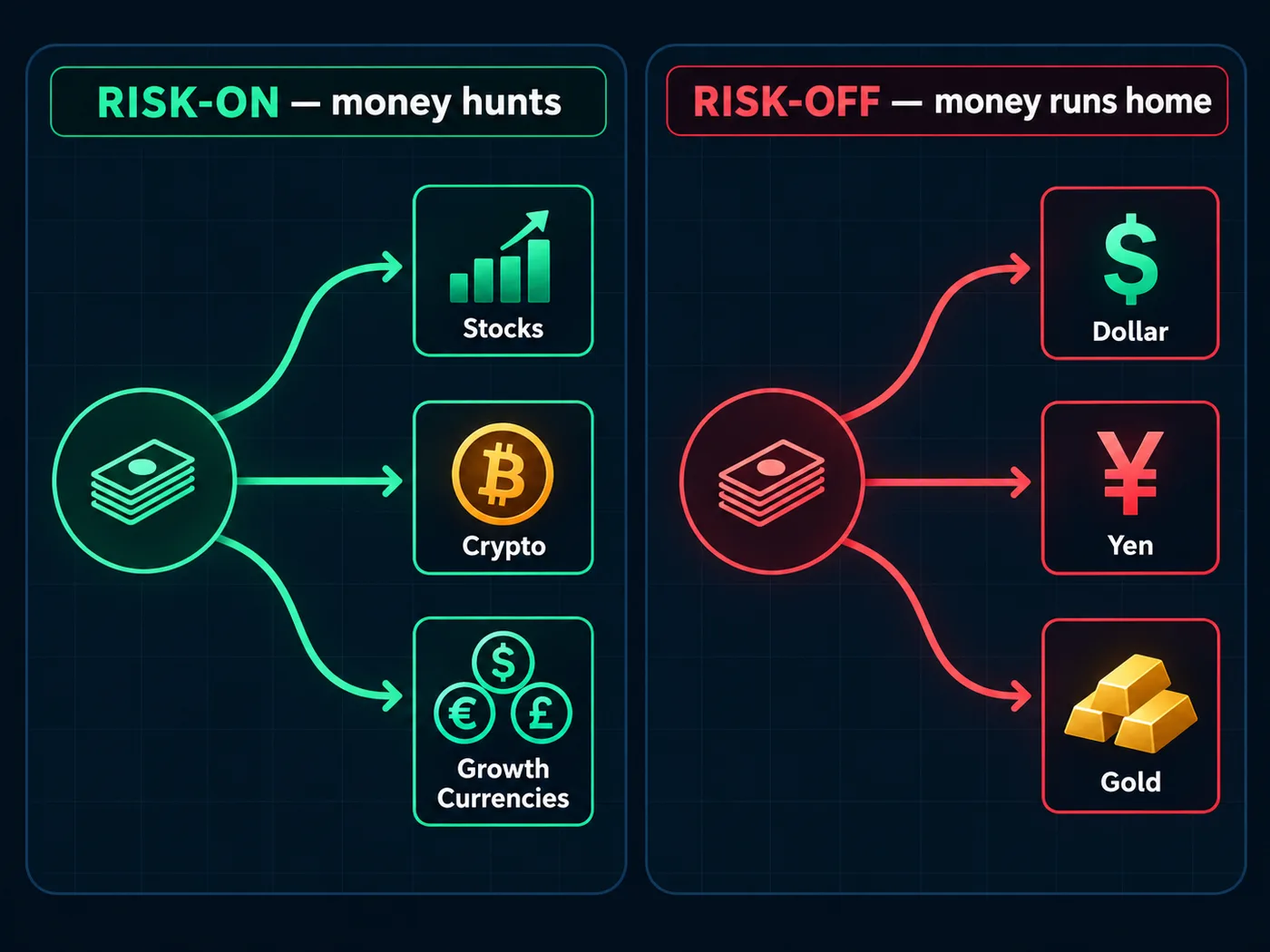
That's why both can move stocks, bonds, the dollar, gold and futures all at once. For the cause-and-effect chain, see how interest rates affect stocks.
Why price can jump on these days
The market has already guessed what CPI will show and what the Fed will say. When reality is different, everyone adjusts at once. That's when you see:
- Big, fast candles. Price can move more in one minute than in the hour before.
- Wider spreads. The gap between the buy and sell price — the Spread — can widen for a short time.
- Slippage. A stop can fill at a worse price than you set, because price jumped past it. That's Slippage.
- Fake first moves. Price may shoot one way, then turn and go the other way within minutes.
FOMC days add a twist: the statement at 2:00 pm can move price one way, and the press conference at 2:30 pm can move it again — sometimes the other way.
Normal rules may not fit. Your stop is set for a normal day's moves. On news, price can blow past it in a second. That's why many traders simply step aside.
A simple beginner plan
Keep it boring on purpose. Boring is good on news days.
- Know the date. Check your economic calendar on Sunday. Write CPI and FOMC times on a note.
- No new trades 15–30 minutes before. Stop looking for entries ahead of 8:30 am (CPI) or 2:00 pm (FOMC).
- Decide about open trades early. Close them before the news, or keep them only with a stop in place and a size you're truly fine losing — knowing slippage is possible.
- No new trades 15–30 minutes after. Let the first wild candles finish. On FOMC days, wait until the press conference has been going for a while too.
- Then trade your normal plan. Mark where price last turned around. Wait for a candle body to close past it. Normal size, normal checklist.
- Keep your daily stop. Two losses and you're done, news or not. See daily loss limits.
Skipping the day is a valid plan. If news days feel too fast, don't trade them at all while you learn. Use the time to watch, take notes, and practice on past charts instead.
What about futures and forex?
These events matter for almost every market, not only stocks:
- Index futures (like the S&P 500 and Nasdaq futures) trade nearly around the clock, so they react the second CPI comes out at 8:30 am — an hour before the stock market opens at 9:30 am ET.
- Forex: CPI lands inside the London–New York overlap, the busiest forex window. See the best time to trade forex.
If you trade futures, remember that a fast move is measured in ticks, and ticks add up quickly. The futures tick value calculator shows what a move costs per contract.
Try it today
- Find the next CPI date on the BLS schedule and the next FOMC date on the Fed's calendar.
- Add both to your phone calendar with an alarm 30 minutes before.
- Write "no new trades 30 min before and after" in your trading plan.
- On the next CPI day, just watch a 1-minute chart from 8:20 to 9:00 am ET. Take notes. No trades.
Questions
What time is CPI released?
At 8:30 am Eastern Time, once a month, usually around the middle of the month. The BLS publishes the full schedule in advance.
What time is the FOMC announcement?
The rate decision and statement come out at 2:00 pm ET on the last day of the meeting, followed by the Fed chair's press conference at 2:30 pm ET.
How many times a year does the FOMC meet?
Eight scheduled times a year. It can also hold extra meetings if needed.
Should I trade on CPI day?
Many beginners do best by opening no new trades for 15–30 minutes before and after the release, then following their normal plan — or skipping the day and just watching.
Why do spreads widen during news?
Right around a big release, many traders pull their orders and wait. With fewer orders on each side, the gap between the buy and sell price can widen for a short time.
Want the next step? We'll walk you through it.
Four free lessons by email, one every few days — each with a 10-minute exercise on a real chart.
Send Me the Free Lessons 4 short emails · No spam · Unsubscribe anytimeOr see the whole method, step by step:
See What’s Inside the Course Try everything free first. Decide when you're ready. · Open the free chart tool (works in the TradingView phone app)One chart idea a day, in plain English. Follow along: