
How to handle a losing streak in trading: a calm 5-step plan
Every method has losing streaks, even good ones. The question isn't how to never have one. It's what to check, and what to change, while you're in it.
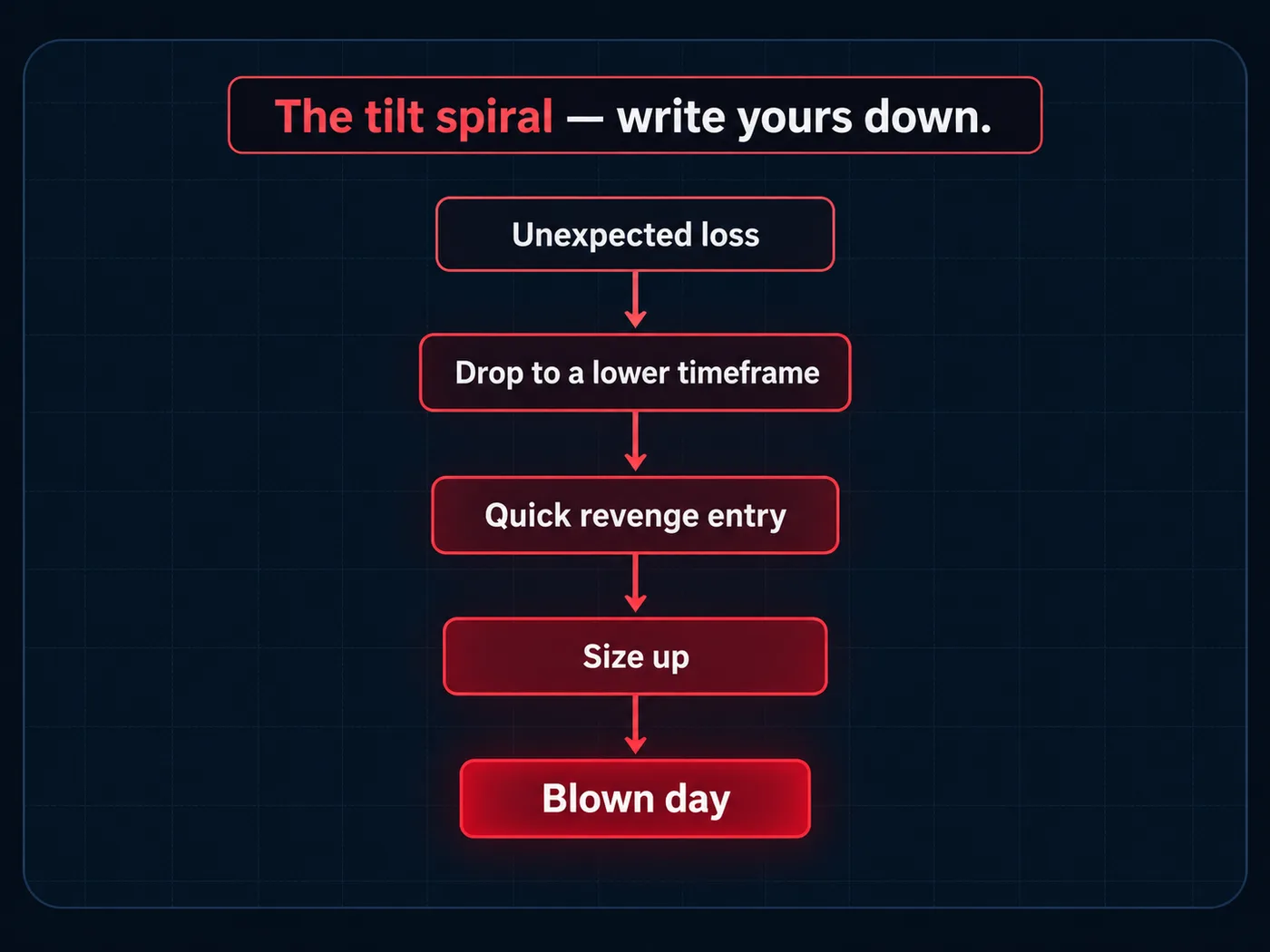
Streaks are part of the math
Here's something most guides skip. Losing streaks don't only happen to bad methods. They happen to every method that wins less than every time.
Think of flipping a fair coin 100 times. Getting 5 tails in a row somewhere in those 100 flips is more likely than not. Nobody thinks the coin is broken.
Trading is similar. If your method wins about half the time, a run of 5 or 6 losses can show up in a normal set of 100 trades. That's a math example, not a prediction. It just shows that a streak by itself doesn't prove something is wrong.
What a streak costs, in units
This is why risk per trade matters so much. Here's a math example in units of risk, where 1 unit is your planned loss on one trade.
| Risk per trade | 6 losses in a row (approx.) |
|---|---|
| 0.5% of account | about −3% |
| 1% of account | about −6% |
| 3% of account | about −17% |
| 5% of account | about −26% |
At 1%, a 6-loss streak is uncomfortable but small. At 5%, the same streak is a deep hole. The loss recovery calculator shows how much bigger the climb back gets as the Drawdown deepens. Small risk per trade is what makes streaks survivable.
Step 1: Stop adding to it today
First, protect the rest of today. If you hit your daily loss limit, you're done. Many traders use "2 losses = done for the day".
Don't try to end the streak with one more trade. The next trade has no idea a streak is happening. More in daily loss limit and revenge trading.
Step 2: Sort the losses into two piles
Open your journal. For every trade in the streak, ask one question: did I follow every rule?
- Pile A: rules followed. These are good trades with bad results.
- Pile B: a rule was broken. Moved stop, skipped checklist, wrong size, a trade that wasn't the setup.
This one step tells you more than anything else. The two piles need very different fixes.
Pile A is not a mistake. If every loss was a rule-following trade, you did your job. The method had a normal rough patch. That's worth knowing, and worth being proud of.
Step 3: If it's mostly pile B, fix the process
Rule breaks during a streak are very common. Losses build pressure, and pressure bends rules. That's human.
Look for the pattern:
- Did breaks start after a certain number of losses?
- Did your size go up as the streak went on?
- Were breaks at a certain time of day?
- What feeling did you write before each one?
Then add one rule or one piece of friction. For example, "After 3 losses in a week, I trade at half size until I log 3 rule-following trades." Our trading discipline guide has more ideas.
Step 4: If it's mostly pile A, check the market
If you followed the rules and still lost, look at what the market was doing. Some methods suit some conditions better than others.
Ask:
- Was the bigger chart trending, or going sideways?
- Was price moving faster or wider than usual?
- Was there a lot of news, like a Fed week or earnings season?
A trend-based method often struggles in a sideways market. That's not a broken method. It's a method waiting for its kind of chart. Writing it down helps you spot those conditions faster next time. See how to identify a trend.
Step 5: Shrink, then rebuild
Once you've sorted the piles, there are a few calm options. Pick the one that fits.
- Half size. Keep trading the plan at half your normal risk. Losses get smaller while you rebuild trust.
- Back to practice. Run 10 to 20 replay or paper trades with the full rule list. Return to real size when they're done.
- A short break. A few days off can reset your head. See how to take a break from trading.
Whatever you choose, set a clear rule for coming back. For example, "Normal size after 5 rule-following trades in a row, win or lose." Notice it counts rule-following, not wins.
Rebuild on process, not results. If your return rule is "after 3 wins", you'll be tempted to force wins. If it's "after 5 clean trades", you'll focus on what you control.
What not to do in a streak
- Don't switch methods on the spot. Every method has streaks. Jumping to a new one resets your learning to zero.
- Don't double the size to win it back. It turns a normal streak into a deep drawdown.
- Don't add more indicators. More lines rarely fix a streak. Usually it's the plan or the conditions.
- Don't judge yourself by it. A streak is a stretch of trades, not a verdict on you.
Looking after yourself
Streaks are tiring. That's real, and it's okay.
Sleep, food and time away from the screen all help you think clearly. Talk to someone you trust if it's weighing on you. Trading is meant to be one part of your life, not all of it.
Try it today
- Check your risk per trade. Would a 6-loss streak be small enough to stay calm?
- Add a "rules followed? yes / no" column to your journal if you don't have one.
- Write your "coming back to normal size" rule into your plan now, before you need it.
Questions
How do I recover from a losing streak in trading?
Stop for the day, sort the losses into rules-followed and rules-broken, fix the process if rules were broken, and come back at smaller size until you log several clean trades.
How many losing trades in a row is normal?
It depends on your win rate, but streaks of 5 or more can happen in any method that wins about half the time. That's why small risk per trade matters.
Should I stop trading after a losing streak?
A short pause, smaller size or a return to practice can all help. Pick one and set a clear, process-based rule for when you return to normal size.
Does a losing streak mean my strategy doesn't work?
Not on its own. Check whether you followed your rules and what the market was doing. A method needs many trades, often 50 to 100, before you can judge it.
Want the next step? We'll walk you through it.
Four free lessons by email, one every few days — each with a 10-minute exercise on a real chart.
Send Me the Free Lessons 4 short emails · No spam · Unsubscribe anytimeOr see the whole method, step by step:
See What’s Inside the Course Try everything free first. Decide when you're ready. · Open the free chart tool (works in the TradingView phone app)One chart idea a day, in plain English. Follow along: