
Fed vs ECB: the two central banks behind EUR/USD
The world's most traded currency pair is really a tug of war between two central banks. Knowing how the Fed and the ECB work tells you why EUR/USD jumps on their decision days.
The short answer
The Federal Reserve (the Fed) is the Central bank of the United States. It sets US short-term interest rates for the dollar.
The European Central Bank (ECB) is the central bank for the euro area, the countries that use the euro. Since Bulgaria joined on January 1, 2026, that's 21 countries.
Both raise rates to cool inflation and cut rates to support a weak economy. Their goals and their setup differ.
Side by side
| Federal Reserve | European Central Bank | |
|---|---|---|
| Currency | US dollar | Euro |
| Founded | 1913 | 1998 |
| Based in | Washington, D.C. | Frankfurt, Germany |
| Rate-setting group | FOMC (Federal Open Market Committee) | Governing Council |
| Mandate | Two goals: maximum employment and stable prices | Main goal: price stability |
| Inflation target | 2%, measured by PCE | 2%, symmetric, over the medium term |
| Key rate | Federal funds target range | Deposit facility rate (main signal) |
| Policy meetings | 8 a year | About every six weeks (8 a year) |
| Decision time | 2:00 pm ET, press conference 2:30 pm | 2:15 pm Frankfurt time (often 8:15 am ET), press conference 45 minutes later |
How the Fed works
The FOMC has 12 voting members: the seven Fed governors, the president of the New York Fed, and four other regional Fed presidents who rotate each year.
It sets a target range for the Fed funds rate, the rate banks charge each other overnight. The statement comes out at 2:00 pm ET and the chair speaks at 2:30 pm. See the FOMC meeting explained.
Because it has two goals, the Fed weighs jobs as well as inflation. A weak jobs report can matter as much as a hot inflation report.
How the ECB works
The Governing Council is made up of the six members of the ECB's Executive Board plus the central bank governors of each euro area country. Governors vote on a rotation.
It sets three key rates. Since 2024, the ECB has said the deposit facility rate, what banks earn on money parked at the central bank, is the one it uses to signal its policy.
Its one main goal is price stability. It still cares about growth, but inflation comes first by law.
Why both move EUR/USD
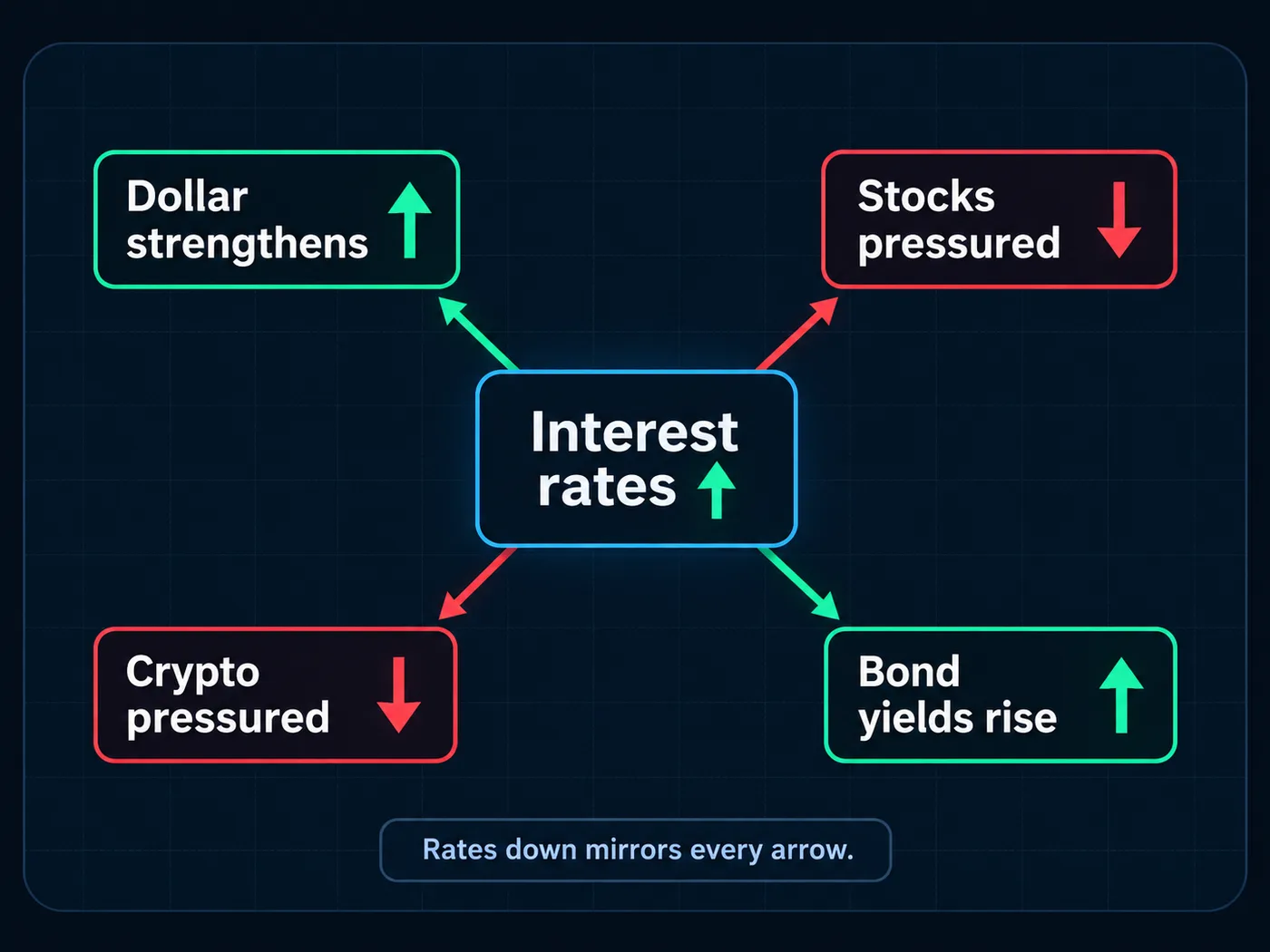
EUR/USD is the price of one euro in dollars. Money tends to flow toward the currency whose rates are rising or expected to rise.
- Fed sounds tougher on inflation than expected: the dollar often firms, and EUR/USD can dip.
- ECB sounds tougher than expected: the euro often firms, and EUR/USD can rise.
- Both surprise in the same direction: the moves can cancel out.
"Tougher" and "softer" are called Hawkish and dovish. The surprise vs what markets expected matters more than the decision itself.
ECB time in ET shifts twice a year. Europe and the US change their clocks on different dates in March and in October-November. For a week or two, the ECB decision lands an hour earlier or later in ET than usual. Check your calendar in your own time zone.
Which fits you?
You don't choose a central bank. You plan around both:
- Trading EUR/USD or other euro pairs: mark both decision days on your calendar. See how to read an economic calendar.
- Trading US stocks or index futures: the Fed matters most. See CPI and FOMC days.
- New to news days: many beginners stay flat into the decision and wait until the press conference is over.
Common mistakes
- Trading the decision itself. Most decisions are expected. The words and the press conference often move price more.
- Forgetting the press conference. The first move at 2:00 pm ET can reverse at 2:30 pm.
- Getting the ECB time wrong. Clock changes catch people out every year.
- Holding full size through the release. Spreads widen and price can gap past a stop. Size from a wider stop with the pip value calculator and position size calculator.
Questions
What is the difference between the Fed and the ECB?
The Fed is the US central bank and has two goals, maximum employment and stable prices. The ECB is the central bank for the euro area and has one main goal, price stability. Both target 2% inflation and meet about eight times a year.
What time does the ECB announce rates in New York time?
The decision is published at 2:15 pm Frankfurt time, which is usually 8:15 am ET. The press conference starts 45 minutes later. Clock changes can shift this by an hour for a week or two each year.
How many countries use the euro?
21, since Bulgaria joined the euro area on January 1, 2026.
Why does EUR/USD move on Fed and ECB days?
Interest rates affect where money flows. If one central bank sounds more likely to keep rates higher than the market expected, its currency often gains against the other.
Want the next step? We'll walk you through it.
Four free lessons by email, one every few days — each with a 10-minute exercise on a real chart.
Send Me the Free Lessons 4 short emails · No spam · Unsubscribe anytimeOr see the whole method, step by step:
See What’s Inside the Course Try everything free first. Decide when you're ready. · Open the free chart tool (works in the TradingView phone app)One chart idea a day, in plain English. Follow along: