
OCO vs bracket order: set your exit before you enter
An OCO order links two exits so only one can fill. A bracket order adds the entry. Both let your plan run without you watching every tick.
The short answer
An OCO order (one-cancels-other) is a pair of orders. When one fills, the other is canceled. Traders often use it for a stop and a target on a trade they're already in.
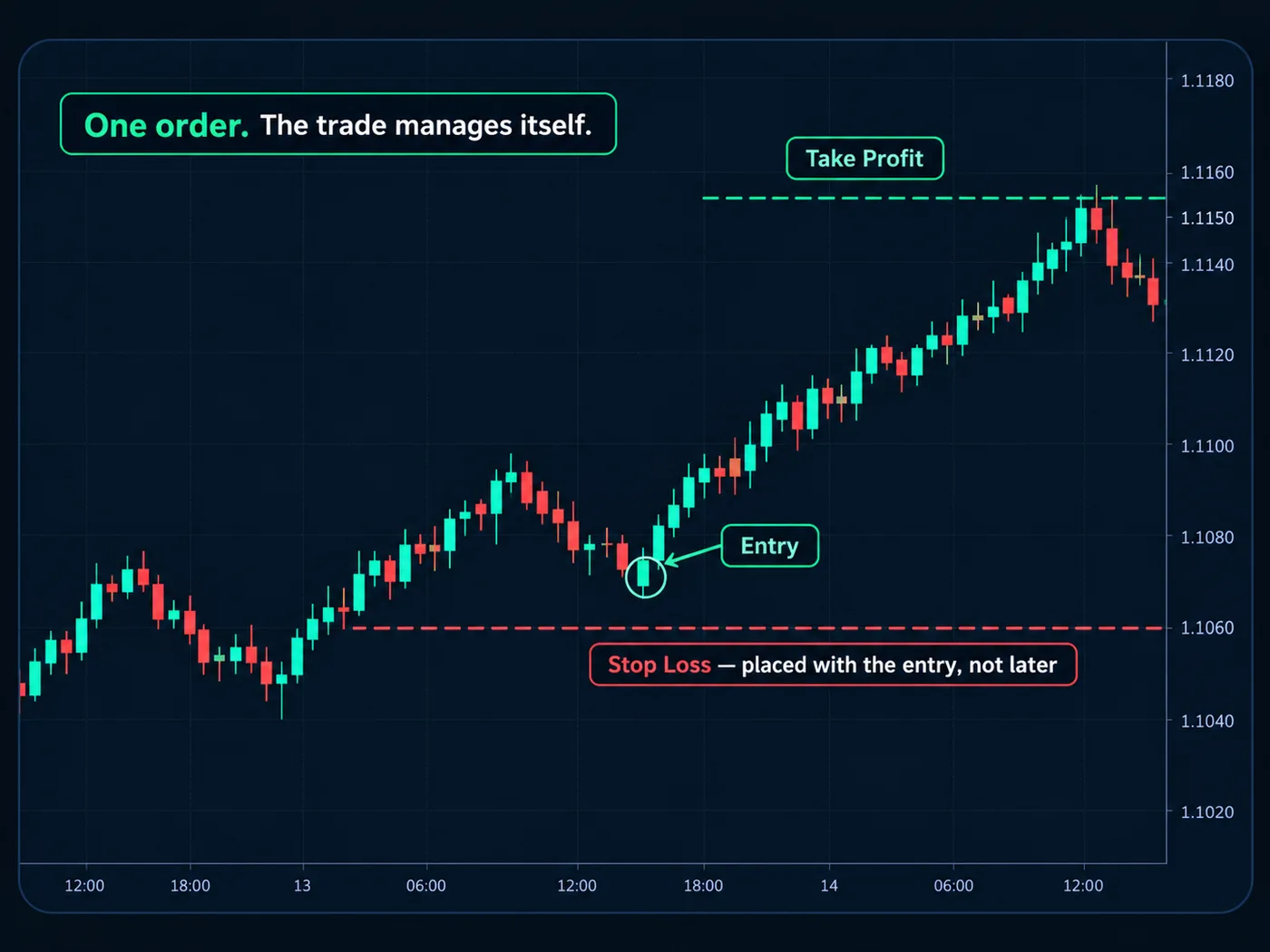
A Bracket order is a full plan in one ticket: an entry order, plus a stop and a target that wait in the background. When the entry fills, the stop and target switch on as an OCO pair.
In short: a bracket is an entry with an OCO attached.
Side by side
| OCO order | Bracket order | |
|---|---|---|
| Parts | 2 orders | 3 orders: entry, stop, target |
| Includes the entry? | No | Yes |
| When you use it | You're already in a trade | Before you enter |
| What happens on a fill | The other order cancels | Entry fill turns on the stop and target; one exit cancels the other |
| Main job | Manage an open trade | Plan the whole trade at once |
| Also used for | Two entries, like a breakout either way | Most planned trades |
| Platform support | Most brokers | Most brokers, sometimes called "attached orders" |
How an OCO works
You bought a stock at $50. You plan:
- A sell stop at $48 (your Stop loss).
- A sell limit at $54 (your Take profit).
Place them as an OCO. If price hits $54 first, the target fills and the stop is canceled. If price hits $48 first, the stop fills and the target is canceled.
Without the link, you could end up with an extra order still live after you're out. If price later hit it, you'd be in a new trade you never planned.
How a bracket works
Same plan, placed before you enter:
- Entry: buy limit at $50.
- Stop: sell stop at $48.
- Target: sell limit at $54.
Nothing but the entry is live at first. When the entry fills, the stop and target turn on. When one of those fills, the other cancels.
Risk is $2 a share. Reward is $4 a share. That's a 2:1 plan. That's a math example, not a promise. The risk-reward calculator checks this for you.
OCO: strengths and limits
The good parts:
- Clean exits. No leftover orders after the trade ends.
- Flexible. Add it to a trade you entered by hand.
- Two-way entries. Some traders place a buy stop above a range and a sell stop below it as an OCO.
The limits:
- No entry included. You still have to enter separately.
- Easy to forget. Entering first and adding exits "in a minute" leaves a gap with no stop.
Bracket: strengths and limits
The good parts:
- The whole plan, once. Risk is set before anything happens.
- Calm. You decide while the market is quiet, not mid-move.
- Matches a checklist. Entry, stop, target, size: all written before you click. See pre-trade checklist.
The limits:
- Less room to adjust. Changing one leg on some platforms changes or cancels the others.
- Unfilled entries can linger. If price never reaches your entry, cancel it when the setup is gone.
- Exits aren't guaranteed prices. The stop leg is usually a stop order, which can slip in gaps.
Size first, then bracket. Your stop distance sets your size. $2 risk a share and $100 to risk means 50 shares. The position size calculator does this in seconds.
Which fits you?
- You plan trades ahead of time. A bracket fits best. One ticket, whole plan.
- You enter by hand at the moment. Add an OCO right after the fill, before anything else.
- You want to catch a breakout either way. Two entry stops linked as an OCO can do that, each with its own stop.
Common mistakes
- Placing a stop and a target as two separate orders. If one fills, the other stays live.
- Moving the stop leg further away once in the trade. That's raising risk mid-trade.
- Leaving a stale entry working after the setup changed.
- Assuming the stop fills at its price. In gaps, it can fill worse. See stop loss vs stop-limit.
Questions
What is the difference between an OCO and a bracket order?
An OCO links two orders so one cancels the other. A bracket adds an entry order, and once the entry fills, its stop and target act as an OCO pair.
Does TradingView support bracket orders?
When you trade through a connected broker on TradingView, you can usually add a stop loss and take profit to an order. What's available depends on the broker.
Can I use an OCO order for entries?
Yes. Some traders place a buy stop above a range and a sell stop below it as an OCO, so only one side triggers. Each still needs its own stop.
What happens to a bracket if the entry never fills?
The stop and target never turn on. The entry stays working until it fills, you cancel it, or it expires based on its time setting.
Want the next step? We'll walk you through it.
Four free lessons by email, one every few days — each with a 10-minute exercise on a real chart.
Send Me the Free Lessons 4 short emails · No spam · Unsubscribe anytimeOr see the whole method, step by step:
See What’s Inside the Course Try everything free first. Decide when you're ready. · Open the free chart tool (works in the TradingView phone app)One chart idea a day, in plain English. Follow along: