
Trading psychology for beginners: why rules beat willpower
Knowing what to do is the easy part. Doing it with real money on the screen is the skill, and it's one you can build with simple written rules.
What trading psychology really means
Trading psychology is how your feelings change your decisions. Excitement makes you jump in early. A loss makes you want to win it back fast. Boredom makes you take trades that aren't there.
This happens to everyone, including people who have traded for years. It isn't a weakness. It's how human brains react to money going up and down in real time.
So the goal isn't to become a robot. The goal is to set things up so your feelings can't make the big decisions.
Why willpower runs out
Willpower is like a phone battery. It's full in the morning and drains with every hard choice. After a few tense trades, there's less left — and that's exactly when the tempting, rushed trade shows up.
Rules don't drain. A rule you wrote down yesterday, when you were calm, works just as well after three trades as before the first one. That's why experienced traders lean on rules, not on "trying harder".
The big idea: make your decisions before the market opens, while you're calm. During the session, your only job is to follow what calm-you already decided.
Write your rules down
A rule in your head can be bent. A rule on paper is harder to argue with. Keep your list short enough to fit on a card:
- What a setup looks like. For us: price comes back to a zone where it turned around before, on the side of the bigger trend.
- How much you risk. A small, fixed slice — many traders use about 1% of the account. See how much to risk per trade.
- Where your stop goes. Set from the chart, before you get in. Then use the position size calculator to size the trade.
- When you stop for the day. Two losses and you're done. More in daily loss limits.
- When you don't trade at all. For example, the minutes around big news.
All of this belongs in one place: your trading plan.
Use a checklist, every time
Pilots run a checklist before every flight, even after 10,000 flights. Not because they forget — because checklists catch the one time they would have.
A trading checklist works the same way. Before you click buy or sell, you answer the same few questions, in the same order. If one answer is "no", that's a reason to stop and look again. We walk through a full one in the pre-trade checklist guide.
A short version:
- Does the bigger chart agree with this direction?
- Is price at one of my marked zones, not in the middle?
- Is my stop set from the chart, and is my size from the math?
- Is the target at least twice what I'm risking?
- Is there big news in the next 30 minutes?
The state check: one question about you
The checklist looks at the chart. The state check looks at the trader. Before every trade, ask yourself one honest question: "How do I feel right now?"
Pick one word:
| How I feel | What it usually means |
|---|---|
| Calm | Good. Follow the checklist as normal. |
| Confident | Fine — just make sure it's not "too sure". Size stays the same. |
| FOMO (fear of missing out) | You may be chasing. Wait for price to come to your zone. |
| Revenge | You want a loss back. This is the moment to step away. |
| Bored | You may be looking for action, not a setup. |
| Tired | Your judgment is slower. Smaller day, or no day. |
The point isn't to judge yourself. It's to notice. A feeling you name out loud has much less power than one you don't see. Writing it in your journal next to the trade is even better — over time you'll see which feelings go with which results. Our trading journal guide shows how.
The step-away moments
Some moments call for walking away from the screen. Not forever — for a few minutes, or for the rest of the day. Three to learn by heart:
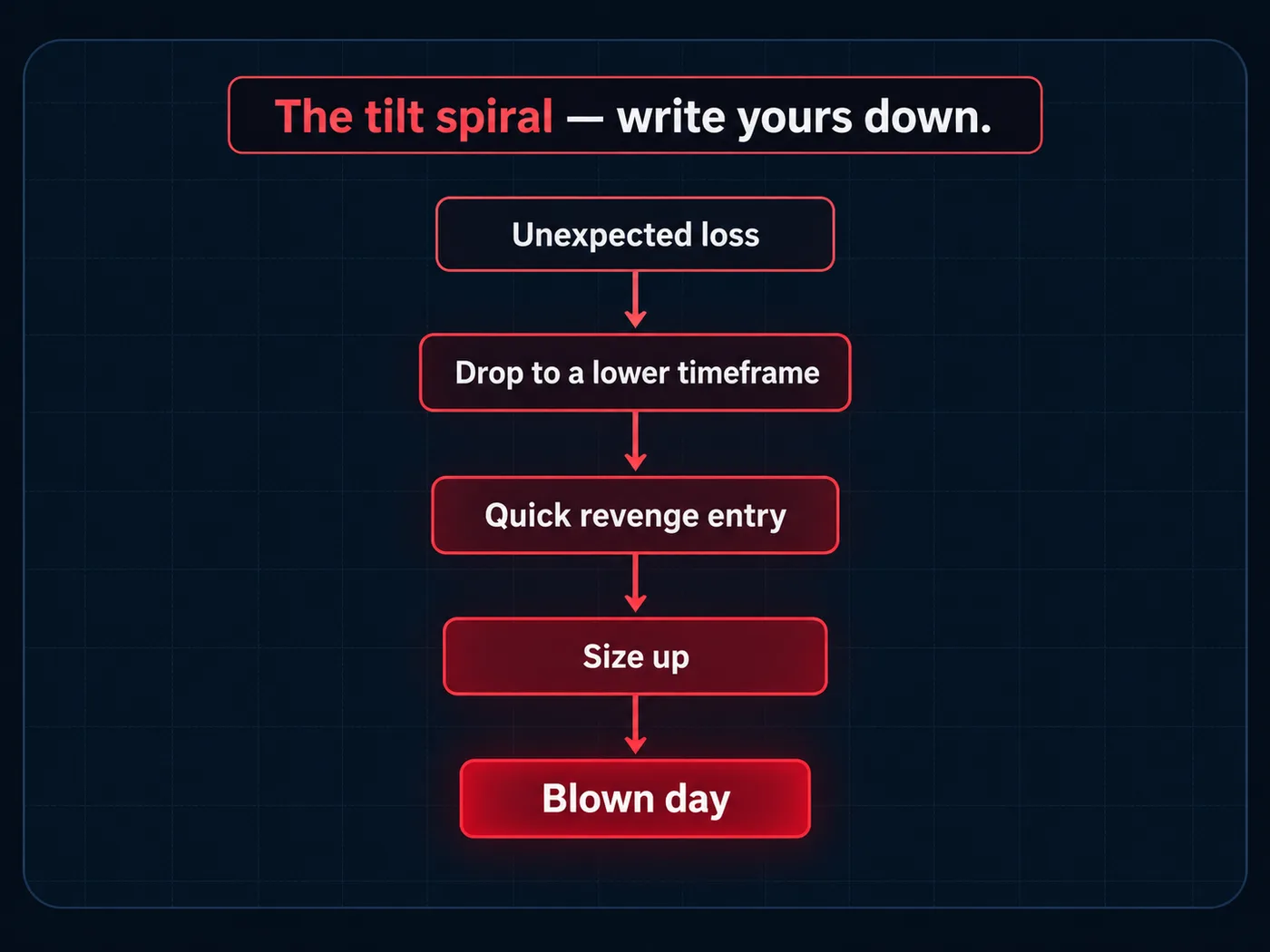
- Right after a loss. The urge to jump straight back in is strongest here. Stand up, get water, come back in 10 minutes. See revenge trading.
- When you hit your daily stop. Two losses means the day is over. No "one more".
- When a move already left without you. Chasing it is how small misses turn into real losses. See FOMO trading.
Make it physical. Stepping away works best when it's a real action: close the trading app, put the phone in another room, set a timer. A decision you can undo with one tap isn't a break.
Practice the rules where it's safe
Rules are easiest to learn when nothing is at stake. Practice on past charts with replay, log every trade, and run your checklist each time — just like you would with real money. Our guide to practice trading without money shows the steps.
If the rules feel natural in practice, they're much easier to follow later. If you skip them in practice, you'll skip them when it counts.
Try it today
- Write five rules on a card: setup, risk, stop, daily stop, no-trade times.
- Write the five checklist questions underneath.
- On your next practice trade, run the list and pick one word for how you feel.
- Write that word in your journal next to the trade.
Questions
Can you learn trading psychology?
Yes. You don't change your feelings — you build habits around them. A written plan, a checklist and a daily stop do most of the work, and they get easier with practice.
Why do I break my trading rules?
Because the rule lives in your head and the feeling is right in front of you. Write rules down, check them before every trade, and decide your daily stop before the session starts.
What is the most important part of trading psychology?
Accepting that losses are part of trading. Every trader has them. When a loss is small and planned, it's easy to take — and easy to move on from.
Should I trade when I feel emotional?
Run the state check. If the honest answer is revenge, FOMO or tired, the safest choice is usually to step away, or keep it to practice for the day.
Want the next step? We'll walk you through it.
Four free lessons by email, one every few days — each with a 10-minute exercise on a real chart.
Send Me the Free Lessons 4 short emails · No spam · Unsubscribe anytimeOr see the whole method, step by step:
See What’s Inside the Course Try everything free first. Decide when you're ready. · Open the free chart tool (works in the TradingView phone app)One chart idea a day, in plain English. Follow along: