
Trading with a full-time job: a 20-minute routine
You don't need to watch charts all day to learn to trade. Plenty of traders do it in the evening, on charts that only change once a day. Here's how that works, and a 20-minute routine to try.
The big idea: let the chart come to you
A lot of trading advice assumes you sit at a screen from 9:30 am. With a job, that's not realistic. And it doesn't need to be.
The fix is to use a slower chart. On a daily chart, each candle is one whole day. It only finishes once, at the close. So you only need to look once.
Many people dream of more time and more say over their own day. That kind of goal starts with a skill, and you can build that skill around the job you have now.
Why swing trading fits a busy week
Swing trading means holding a trade for a few days to a few weeks, aiming to catch one "swing" in price. It suits a full-time job for three reasons:
- Fewer decisions. A daily chart might give you a few setups a week across your whole watchlist, not dozens a day.
- No rush. You decide in the evening, with the day's candle already closed.
- Orders do the waiting. Your entry, stop and target can sit with your broker while you work.
Day trading, by contrast, needs you watching during market hours. Our day trading vs swing trading comparison lays out the trade-offs.
What "end-of-day" means
You look at the chart after the market closes, when the day's candle is final.
- US stocks: the regular session ends at 4:00 pm ET.
- Forex: the trading day is usually counted as ending at 5:00 pm ET.
- Crypto never closes, so pick one fixed time and treat it as your "close."
Looking after the close does one big thing: it stops you from reacting to every wiggle in the middle of the day. Only a candle that has closed counts.
The 20-minute evening routine
Set a timer. Do the same steps in the same order every evening.
- Check the calendar (2 min). Any big news tomorrow, like a Fed meeting or a jobs report? If so, note it. Our economic calendar guide shows what to look for.
- Check open trades (3 min). Is each stop still in place? Did anything hit its stop or target? Log it.
- Scan your watchlist (8 min). Open each market's daily chart. Is it trending up, down or sideways? Is price near a level you've marked? Keep it to 5–10 markets. See how to build a watchlist.
- Plan, don't chase (5 min). For any setup, write one sentence: why here, where the stop goes, where the target is. Size it with the position size calculator.
- Place or skip (2 min). If it passes your pre-trade checklist, place the orders. If not, close the laptop. Skipping is a fine result.
Most evenings, you'll place nothing. That's the routine working, not failing. A quiet evening is a good sign that you're waiting for clear setups.
Orders that work while you're at work
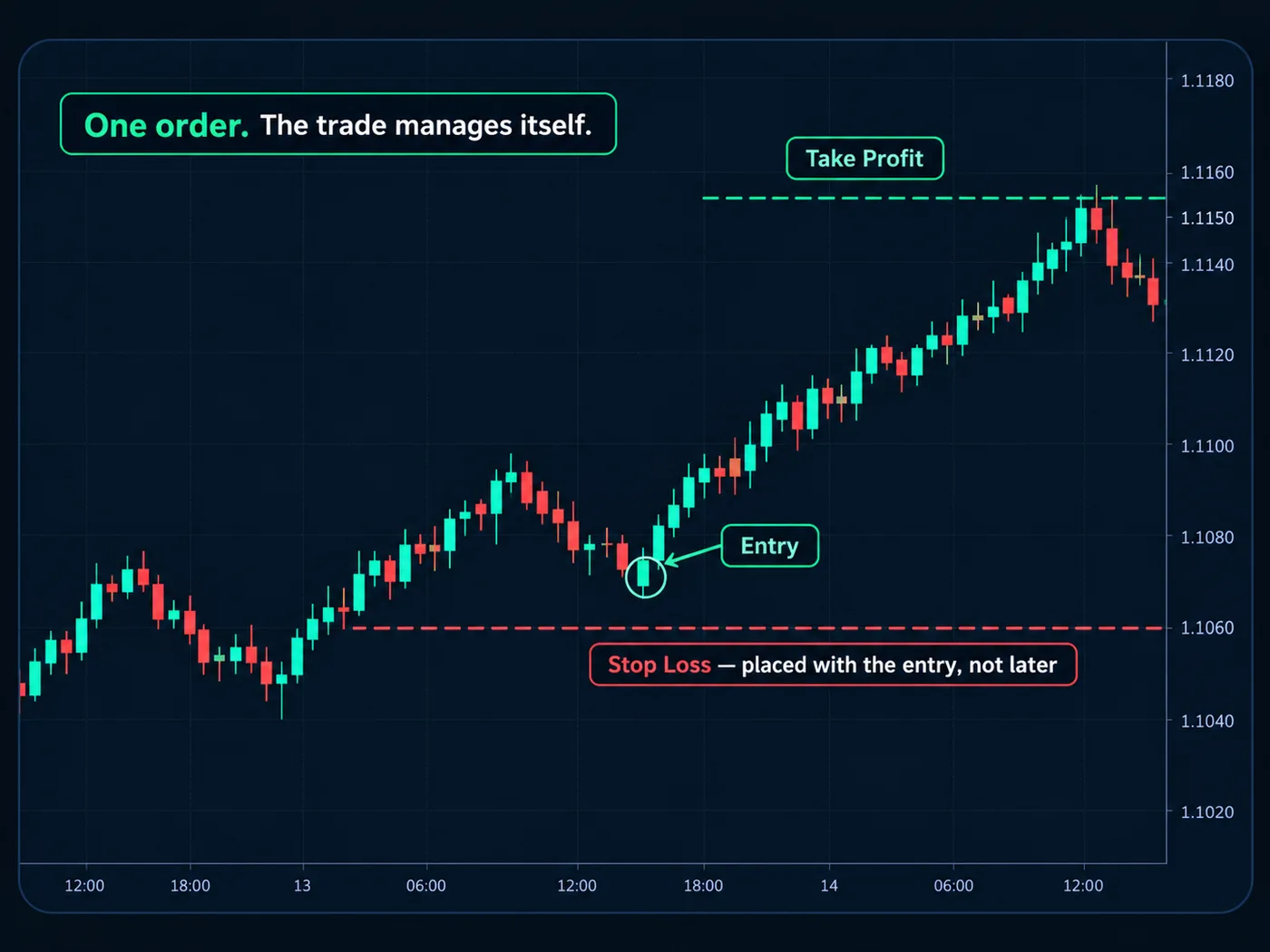
You can't babysit a trade from a meeting. So the trade has to manage itself.
- Stop order: gets you out if price hits your "I was wrong" level. Every trade gets one before you walk away. See how to set a stop-loss.
- Limit order: takes profit at your target, or enters only at the price you chose.
- Bracket order: an entry with a stop and a target attached, all placed at once. Many brokers offer it.
- Good-'til-canceled (GTC): keeps the order alive past today, so it doesn't vanish overnight.
The one risk to know about: gaps
Holding overnight means the market can open at a very different price from where it closed. That jump is a Gap.
If a stock gaps past your stop, your order fills at the next available price, which can be worse than the stop. A gap can turn a planned loss into a bigger one.
How swing traders handle it:
- Keep risk small. About 1% per trade means even a bad gap stays survivable.
- Watch the calendar. Company earnings reports often cause gaps. Many swing traders avoid holding a stock through its earnings date.
- Size from the stop. Never make a trade bigger because you "feel sure."
Practice on your schedule
The good news: the slow chart makes practice easy too. You can replay past daily charts on a weekend morning and log 20 trades in an hour. TradingView bar replay does this for free.
Then paper trade your evening routine for a few weeks, before any real money. The routine itself is the skill you're practicing.
A sample week
| Day | What you do | Time |
|---|---|---|
| Mon–Thu | Evening routine | 20 min |
| Fri | Routine + log the week's trades | 30 min |
| Sat or Sun | Replay practice on past charts | 30–60 min |
That's about 2–3 hours a week. Enough to build a real habit, without taking over your evenings.
Try it today
- Pick 5 markets you'd like to follow.
- Set a phone reminder 30 minutes after your market closes.
- Do the 20-minute routine once, even if you place nothing.
- Write one line in a journal about what you saw.
Questions
Can I trade while working a 9 to 5?
Yes. Swing trading on daily charts lets you plan in the evening and leave orders with your broker. Your entry, stop and target do the waiting while you're at work.
What is the best trading style for someone with a full-time job?
Swing trading on end-of-day charts is the most common choice, because each candle only finishes once a day. It needs one short session each evening rather than watching the market live.
How much time do I need to trade part-time?
A 20-minute evening routine on weekdays plus a short weekend practice session is enough to build the skill. That's roughly 2 to 3 hours a week.
Is it risky to hold trades overnight?
It adds one risk: the price can gap past your stop when the market reopens. Keeping each trade's risk small, about 1% of the account, and avoiding earnings dates helps keep that risk under control.
Can I day trade on my lunch break?
You can, but it's hard to do well. Lunch is short, you can't watch the trade afterwards, and rushed decisions tend to break rules. Most people with a job find swing trading a better fit while they learn.
Want the next step? We'll walk you through it.
Four free lessons by email, one every few days — each with a 10-minute exercise on a real chart.
Send Me the Free Lessons 4 short emails · No spam · Unsubscribe anytimeOr see the whole method, step by step:
See What’s Inside the Course Try everything free first. Decide when you're ready. · Open the free chart tool (works in the TradingView phone app)One chart idea a day, in plain English. Follow along: