
Home › Guides › Markets & the economy
Gold trading for beginners: what moves it, explained
Gold has been valued for thousands of years, and it still moves on today's news. Rates, the dollar and nervous markets all push it around. Here's what drives it, and how to trade it with a plan.
How gold is priced
Gold is priced in US dollars per troy ounce. A troy ounce is about 31.1 grams, a little heavier than a regular ounce.
On charts you'll often see the symbol XAU/USD. It reads just like a currency pair: how many dollars one ounce of gold costs. Gold futures use the symbol GC.
What moves the gold price
Gold doesn't pay interest or earnings. So its price depends mostly on how much people want to hold it, compared with the other things they could own. Five forces matter most.
1. Interest rates
When interest rates rise, cash and bonds pay more. Holding gold, which pays nothing, looks less attractive by comparison. When rates fall, that gap shrinks.
Traders watch real rates most: interest rates minus inflation. That's why Fed days often move gold. The FOMC meets 8 times a year, with its statement at 2:00 pm ET.
2. The US dollar
Gold is priced in dollars. When the dollar gets stronger, gold costs more for buyers using other currencies, which can weigh on the price. A weaker dollar often works the other way. It's a tendency, not a law.
3. Fear and uncertainty
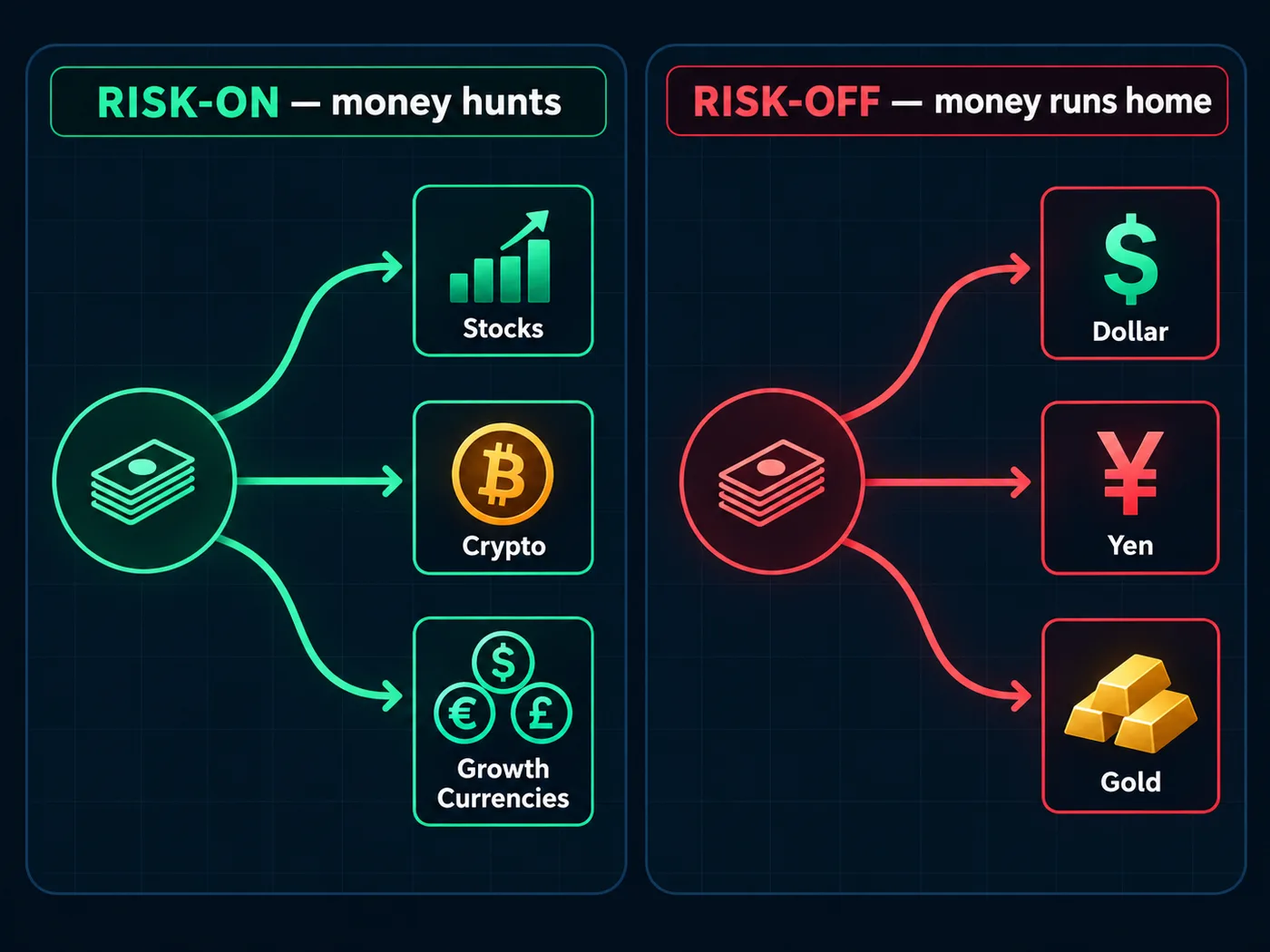
In nervous markets, people often move money toward things they see as safer. Gold is one of them. This is the risk-off mood.
4. Inflation
Many people see gold as a store of value when prices are rising. That's why CPI day, at 8:30 am ET, can move gold sharply in both directions.
5. Big buyers
Central banks, funds and jewelry demand all buy gold. When large buyers step up or step back, it can shift the price over months.
Ways to trade gold in the US
| Way | What it is | Good to know |
|---|---|---|
| Gold ETF | A fund that holds gold and trades like a stock | Normal broker, market hours, no leverage needed |
| Micro gold futures (MGC) | A contract for 10 troy ounces | Leverage, nearly 24-hour trading, fixed tick value |
| Gold futures (GC) | A contract for 100 troy ounces | Ten times the money per move of MGC |
| Gold mining stocks | Shares in companies that dig gold | Move with gold, plus their own company news |
Spot gold CFDs, common in some other countries, aren't offered to US retail traders. For many US beginners, an ETF is the simplest way to follow gold, and micro futures are the step after.
The tick math for gold futures
A Tick is the smallest step a futures price can move. For both gold contracts, it's $0.10 an ounce.
| Contract | Size | Tick | Tick value |
|---|---|---|---|
| GC (Gold) | 100 troy oz | $0.10 | $10.00 |
| MGC (Micro Gold) | 10 troy oz | $0.10 | $1.00 |
So a $1 move in the gold price is 10 ticks: $10 on MGC or $100 on GC, per contract. Our futures tick value calculator does this for any move. New to futures? Read futures trading for beginners first.
Sizing a gold trade: an example
Gold can move a lot in a day, so stops are often wide in dollars. That's fine, as long as size comes from the stop.
An illustration: account $10,000, risk 1% = $100. Your stop on MGC is $8 below entry. $8 = 80 ticks × $1 = $80 per contract. $100 ÷ $80 = 1.25, so 1 contract. If the chart needs a $15 stop instead, that's $150 per contract, more than your $100. The answer is to skip the trade, not to move the stop. A math example, not a trade idea.
Notice what this rules out: a full GC contract with that $8 stop would risk $800, or 8% of the account. That's why micros exist.
Reading a gold chart
Gold charts work like any other. The same 4 steps apply:
- Start on the daily chart. Is gold making higher highs and higher lows, or lower ones?
- Mark the turning points. The last places price clearly turned around are your levels.
- Check the calendar. Fed days, CPI and the jobs report can all jolt gold. See CPI and FOMC days.
- Wait for a body close. A tail poking through a level doesn't count. A candle body closing past it does.
Gold and news: in the minutes after CPI or a Fed statement, gold can swing both ways before picking a direction. Many traders wait for the first candle after the news to close before deciding anything.
When gold trades
Gold futures trade nearly 24 hours, Sunday evening to Friday evening US time, with a short daily break. The busiest stretch is usually when London and New York trading hours overlap, in the US morning. Gold ETFs trade during the regular stock session, 9:30 am to 4:00 pm ET. Our market hours tool shows the sessions in your time zone.
Common beginner mistakes with gold
- Calling it "safe." Gold can fall a long way and stay down for years. It's a market like any other.
- Using a full contract too early. One GC contract moves $100 for every $1 in gold.
- Trading through the news. Big reports can blow through a tight stop.
- Forgetting the dollar. If the dollar is ripping higher, gold often has a harder time.
Try it today
- Open a daily gold chart (XAU/USD or GC) on TradingView.
- Mark the trend and the last 2 turning points.
- Find this month's Fed and CPI dates.
- Pick an imaginary stop and work out the cost on 1 MGC contract.
Questions
How do beginners trade gold?
In the US, many start with a gold ETF through a normal broker, then move to micro gold futures (MGC) once they understand leverage and tick values. Either way, decide your risk per trade and your stop before you enter.
What makes the gold price go up?
Falling real interest rates, a weaker US dollar, nervous markets, rising inflation worries and strong buying from central banks and funds can all push gold up. None of them works every time.
How much is one tick on micro gold?
Micro gold (MGC) covers 10 troy ounces and moves in $0.10 ticks, so each tick is worth $1.00 per contract. A $1 move in gold is $10 per MGC contract.
Is gold a safe investment?
Gold is often bought in nervous markets, but its price can still fall sharply and stay low for long periods. Treat it like any other market: fixed risk per trade and a stop from the chart.
What time is best to trade gold?
Gold is usually most active during the US morning, when London and New York hours overlap, and around big US news like CPI and Fed decisions.
Want the next step? We'll walk you through it.
Four free lessons by email, one every few days — each with a 10-minute exercise on a real chart.
Send Me the Free Lessons 4 short emails · No spam · Unsubscribe anytimeOr see the whole method, step by step:
See What’s Inside the Course Try everything free first. Decide when you're ready. · Open the free chart tool (works in the TradingView phone app)One chart idea a day, in plain English. Follow along: