
Trading without a stop loss: what "I'll just wait" misses
Plenty of trades that go against you come back. So skipping the stop can feel smart, for a while. The problem is the trade that doesn't come back, and the math of how much that one can cost.
The myth
The thinking goes: "Stops just get hit and then price turns. If I hold, it'll come back."
And often it does. That's what makes the myth so convincing. Each time a losing trade recovers, it feels like proof. Few guides explain why the wins you remember aren't the whole picture.
What's actually true
No stop turns a small, known loss into an unknown one
A Stop loss is just a decision made in advance: "If price gets here, my idea was wrong, and I'm out." Without it, the loss has no limit except your account.
One big loss can undo many small wins
Example in units of risk: a trader skips stops and lets losers recover. 19 trades come back and close at +1 unit each: +19. The 20th doesn't come back and is closed at −25 units. Total: −6 units, after a run that "almost always worked." A math example, not a promise.
This pattern, many small wins and a rare huge loss, is exactly how a high win rate can hide trouble. See the win rate myth.
Big losses are hard to climb back from
| Loss | Gain needed to get back to even |
|---|---|
| 10% | 11% |
| 25% | 33% |
| 50% | 100% |
| 75% | 300% |
The deeper the hole, the steeper the climb. Try your own numbers in the loss recovery calculator.
Mental stops tend to slip
A "mental stop" means planning to close by hand at a price. It sounds the same, but it relies on acting at the worst moment, when the loss feels most painful. That's when people tend to wait "just a bit more." Our guide on fear of losing explains why that urge is so normal.
The honest limits of a stop
A stop isn't perfect either:
- Gaps: if a market opens far past your stop, the order fills at the next price, which can be worse.
- Slippage: in fast markets, a stop that becomes a market order can fill a little worse.
- Being stopped out early: sometimes price tags the stop and turns.
These are reasons to place stops well and size smaller, not reasons to skip them.
What to do instead
- Find where the idea is wrong. Usually just past the last place price turned around. See how to set a stop loss.
- Give it room beyond obvious levels. See the stop-hunting myth.
- Size from the stop. About 1% risk. The position size calculator works it out.
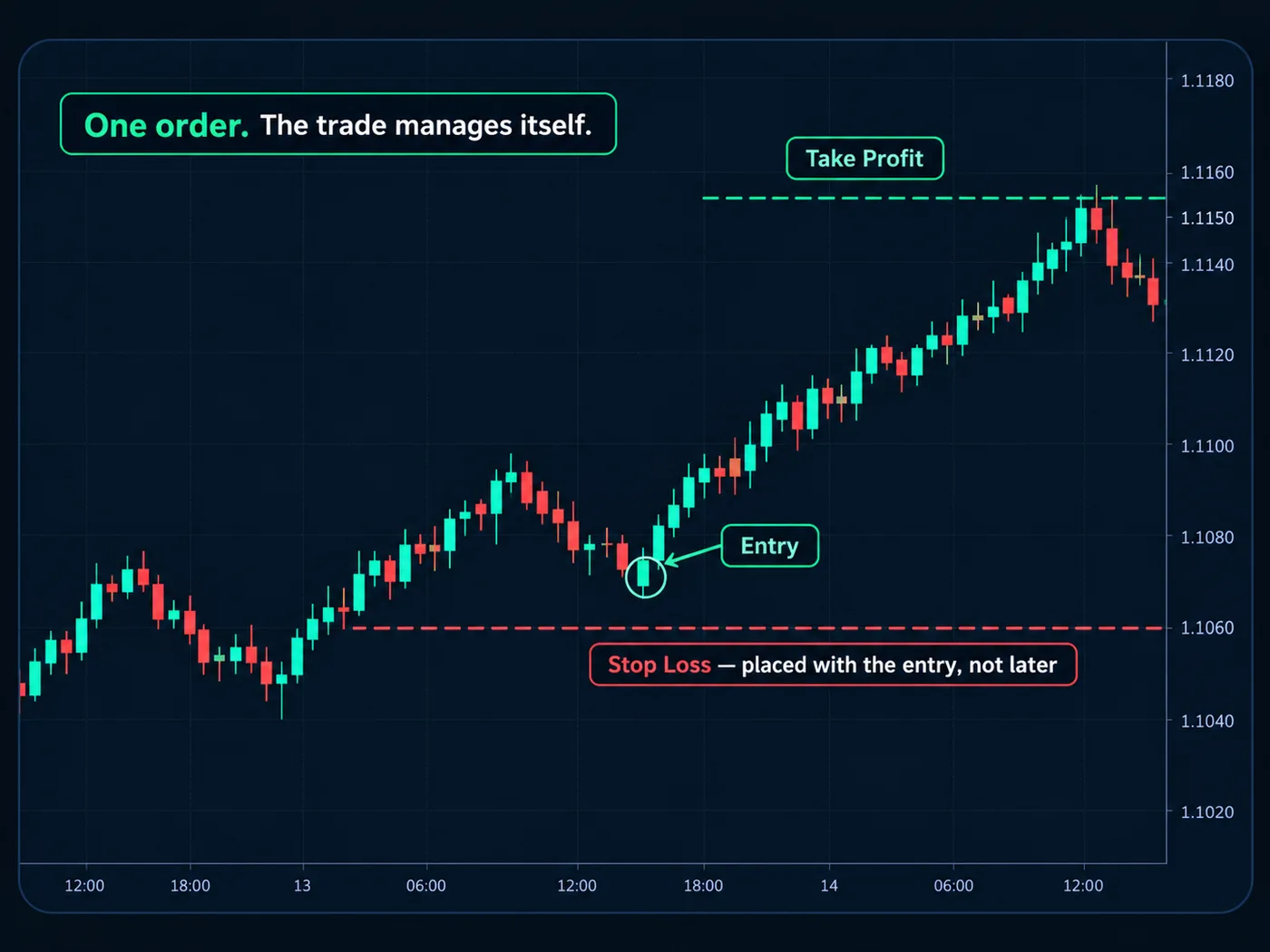
- Place it with the entry as one bracket order, so it's in the market before you can talk yourself out of it.
- Never move it further away. You can move it closer to lock in a planned result. Further away only grows the loss.
Common follow-up mistakes
- Placing the stop so tight it can't breathe, just to trade bigger. Normal wiggles will take it out.
- Removing the stop "just for news." News is when gaps and fast moves are most likely.
- Holding a loser to avoid admitting it. A logged −1 is a normal part of trading, not a mistake.
- Using options or "it's long term" as a reason to drop the exit plan. Every position needs a point where you'd say "I was wrong."
Questions
Is it OK to trade without a stop loss?
It can work for a while, which is what makes it risky. Without a stop, one trade can cost many times your normal loss. Most risk rules start with a stop on every trade.
Are mental stop losses a good idea?
They depend on acting in the moment, when a loss feels worst, so they often slip. A real stop order removes that choice. If you do use one, write it down and treat it as fixed.
Can a stop loss fail?
A stop can fill worse than its price if the market gaps or moves very fast. That's why size matters too: a small size keeps even a worse fill small.
Where should I put my stop loss?
Past the point that proves the idea wrong, usually beyond the last turning point with a little extra room. Then work out the size so hitting it costs your fixed amount.
Want the next step? We'll walk you through it.
Four free lessons by email, one every few days — each with a 10-minute exercise on a real chart.
Send Me the Free Lessons 4 short emails · No spam · Unsubscribe anytimeOr see the whole method, step by step:
See What’s Inside the Course Try everything free first. Decide when you're ready. · Open the free chart tool (works in the TradingView phone app)One chart idea a day, in plain English. Follow along: