
Home › Guides › Candlestick patterns
Pin bar pattern: the rejection candle, explained simply
A pin bar is a candle with one long tail and a small body at the other end. The tail is the footprint of price being turned away. Here's how to measure one, and when it counts.
What a pin bar is
"Pin bar" is short for Pinocchio bar. The long tail is the "nose" that sticks out.
It's a family name, not one shape:
- Bullish pin bar: long tail below, small body near the top. After a fall, this is a hammer.
- Bearish pin bar: long tail above, small body near the bottom. After a rise, this is a shooting star.
This page covers what they share: how to measure the nose, and why a nose poking past a level matters.
How to measure a pin bar
Here's a bearish example on a 4-hour chart:
| Price | Value |
|---|---|
| Open | 212.40 |
| High | 216.00 |
| Low | 211.90 |
| Close | 212.10 |
Now run 3 checks:
- Nose vs body. Body = 212.40 − 212.10 = 0.30. Nose (upper tail) = 216.00 − 212.40 = 3.60. That's 12 times the body. A common rule of thumb is at least 2 to 3 times.
- Nose vs whole candle. Full range = 216.00 − 211.90 = 4.10. The nose is 3.60 of that, about 88%. Many traders want the nose to be about two-thirds or more of the candle.
- Body at the far end. The body sits in the bottom 15% of the candle. The short tail on the other side is just 0.20.
Passes all 3. That's a clean pin bar.
What it says about buyers and sellers
- Price opened at 212.40.
- Buyers pushed it up to 216.00.
- Sellers met them and drove price all the way back.
- It closed at 212.10, near the low.
The nose shows where price went. The body shows where it stayed. When those two are far apart, one side got turned away hard.
The poke past a level
Here's the part most pin bar guides skip.
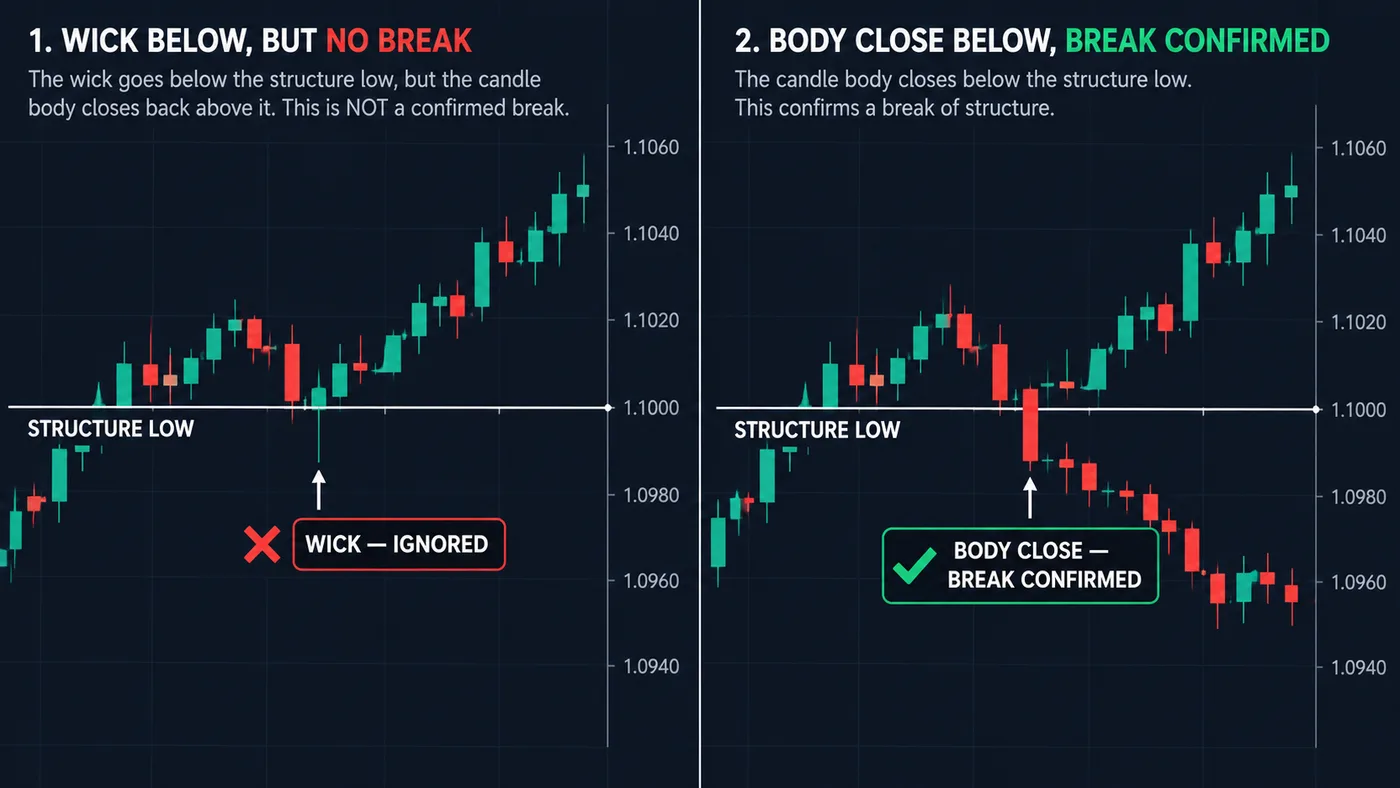
The strongest pin bars don't just have a long nose. The nose pokes past a level that other traders were watching, and the body closes back on the other side of it.
Say there was an old high at 215.00 in our example. The nose went to 216.00, a full point past it. The body closed at 212.10, well back below.
Stops above 215.00 got taken out. Traders who bought the "breakout" are stuck. And the level held anyway. That's a poke past a level, also called a liquidity sweep (see liquidity sweeps explained).
By our rule, only a body close past a level counts. The tail went past. The body didn't. So the breakout failed, and the pin bar is the picture of that failure. More on this test: breakout vs fakeout.
Where it matters
Long tails are everywhere. A pin bar is worth your time when:
- The nose touches or pokes past a clear level. An old high or low, or a support or resistance zone.
- It points against the move into the level. A bearish pin bar after a rise into a ceiling.
- The bigger chart agrees. A bearish pin bar at a ceiling in a bigger downtrend has the wind behind it.
Confirmation: the next body close
The pin bar is the rejection. The next candle shows whether the rejection holds.
- Bearish pin bar: the next candle's body closes below the pin bar's low (211.90 here).
- Bullish pin bar: the next body closes above the pin bar's high.
Some traders enter at the pin bar's close instead. That trades proof for price. Decide which in your plan, not in the moment.
Where the stop goes
The nose marks the spot where the idea breaks. The stop goes just past the tip of the nose.
- Sell on the confirmation close at 211.70.
- Stop at 216.20, just above the 216.00 tip.
- Stop distance: 4.50.
That's the honest cost of a pin bar: the longer the nose, the wider the stop, and the smaller the size. The position size calculator turns that distance into a size that keeps the loss to your fixed slice.
When it fails
It fails often. That's why the stop comes first.
A failed bearish pin bar usually looks like this: the next candle closes back above the pin bar's body, and price climbs past the tip of the nose. This time, buyers broke the level for real, with a body close.
Common mistakes
- Measuring by eye. Run the 3 checks. A "long-ish" tail usually isn't a pin bar.
- Ignoring the level. A nose that pokes past nothing in particular rejected nothing in particular.
- Stop inside the nose. Price often comes back to test part of the nose. A stop there gets hit by normal noise.
- Trading every timeframe. On very short charts, pin bars form all day. Start with the 4-hour or daily.
Try it today
- Pick one market. Mark 3 old highs and lows on the daily chart.
- Use bar replay on the 4-hour chart.
- When a candle forms with a long tail, pause and run the 3 checks with real numbers.
- If it passes, ask: did the nose poke past one of your levels? Write down the stop. Then step forward one candle.
Do 10, and note which ones poked a level.
Questions
What is a pin bar in trading?
A candle with one long tail and a small body at the opposite end. The long tail, or nose, shows price was pushed somewhere and then turned away before the close.
Is a hammer a pin bar?
Yes. A hammer is a bullish pin bar after a fall, and a shooting star is a bearish pin bar after a rise. "Pin bar" is the family name.
How long should a pin bar's tail be?
A common rule of thumb is at least 2 to 3 times the body, and about two-thirds or more of the whole candle. Longer and cleaner is clearer.
Where do you put a stop loss on a pin bar?
Just past the tip of the long tail. If price goes past that point and holds, the rejection didn't hold.
Want the next step? We'll walk you through it.
Four free lessons by email, one every few days — each with a 10-minute exercise on a real chart.
Send Me the Free Lessons 4 short emails · No spam · Unsubscribe anytimeOr see the whole method, step by step:
See What’s Inside the Course Try everything free first. Decide when you're ready. · Open the free chart tool (works in the TradingView phone app)One chart idea a day, in plain English. Follow along: