
Why most traders lose money: 5 causes and the fix for each
It's usually not a lack of brains or effort. It's the way trading is normally taught: strategy first, everything else later. Here are the 5 gaps that advice leaves open, and how to close each one.
What the numbers say, without the scare
You may have seen a line like "most retail accounts lose money." Where does it come from?
In the UK and the EU, regulators require brokers that offer CFDs (a type of leveraged trading product) to publish what share of their retail accounts lost money. Those disclosures commonly show that most of those accounts lose. The exact figure varies by broker and changes over time, so you'll see it on each broker's own site.
That tells us something real: trading is hard, and losses are common. It doesn't tell us why. Let's look at the why, because that's the useful part.
The real problem: what usually gets taught
Most trading content teaches one thing: where to get in. Entry patterns, indicators, signals.
But entries are only one piece. The pieces that decide how a bad week turns out are risk, rules, practice and review. Those rarely make it into a 60-second video.
So here are the 5 gaps, with a fix for each.
1. No fixed risk per trade
What happens: each trade's size is a gut call. A "sure thing" gets a bigger size. One loss on that big trade can undo many small wins.
Why it's so common: most explanations show the entry and skip the math of size.
The fix: risk the same small slice every time. Many traders use about 1% of the account. Then let the stop set the size: money at risk ÷ distance to your stop. Our position size calculator does this in seconds, and how much to risk per trade walks through it.
Why size matters so much: a 50% drop needs a 100% gain just to get back to even. A 10% drop needs about 11%. Small, fixed risk keeps drops in the range you can recover from. See it in the loss recovery calculator.
2. No written plan
What happens: each trade is decided in the moment. Rules change with mood. After a few weeks, nobody can say what the "strategy" even was.
Why it's so common: a plan sounds boring next to a new indicator.
The fix: write one page. Which market, which chart, what a setup looks like, where the stop goes, where the target goes, and when you stop for the day. Our trading plan guide gives you a template. Before each trade, check it against a short pre-trade checklist.
3. Overtrading
What happens: too many trades, in too many markets, on setups that are "close enough." Each one adds costs, like the Spread, and more chances for a mistake.
Why it's so common: sitting still feels like falling behind. Fast markets make every move look urgent.
The fix: fewer markets and a stricter setup. Keep a watchlist of 5–10 markets. Decide in advance the most trades you'll take in a day. More ideas in how to stop overtrading.
4. Revenge trading
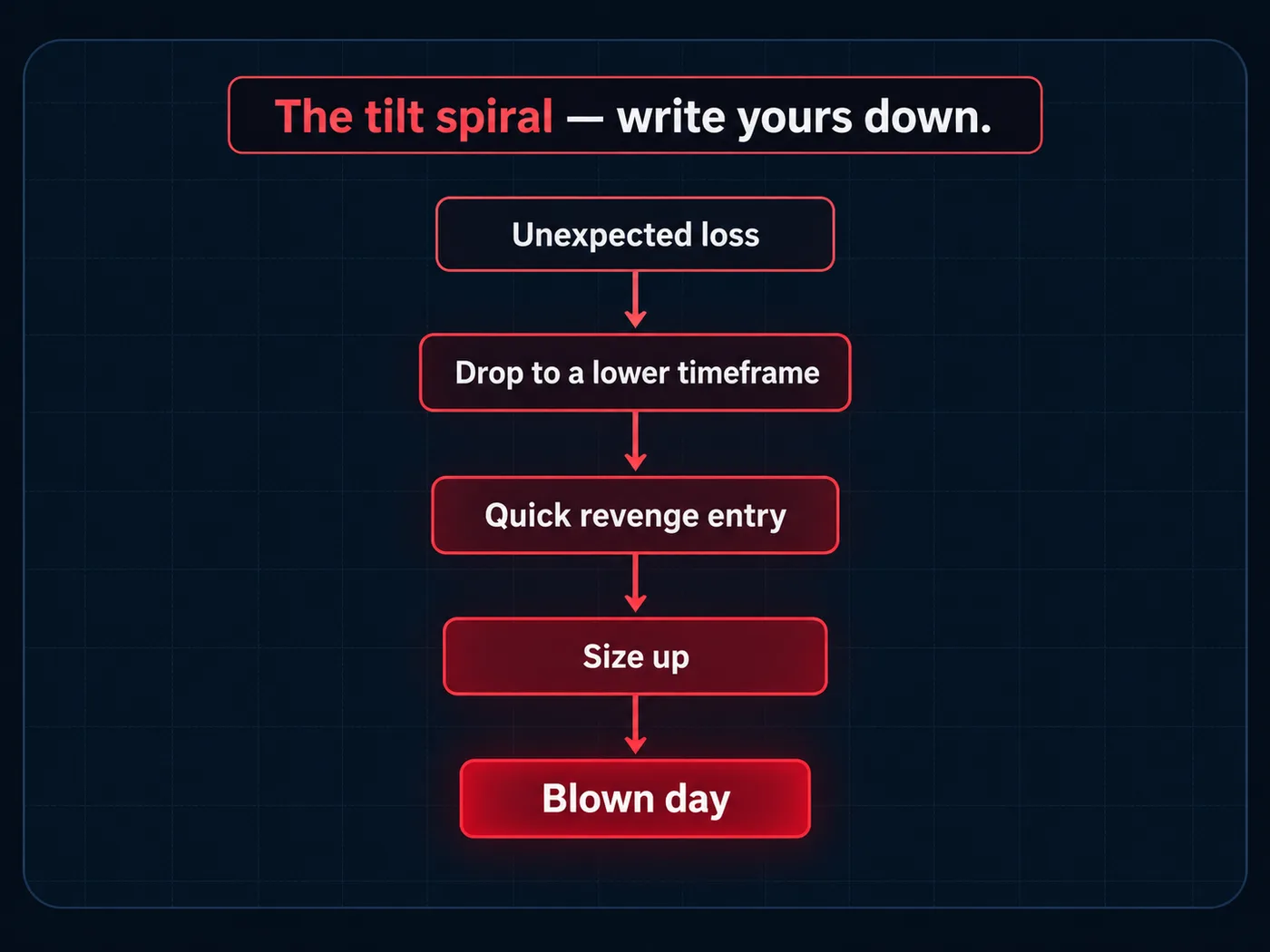
What happens: a loss hurts, so the next trade comes fast and big, to "make it back." It often loses too, and the day spirals.
Why it's so common: it's a normal human reaction. Losses feel sharper than wins of the same size. Nothing is wrong with the person. The rules just weren't there to catch it.
The fix: a daily loss limit, decided before the day starts. A simple one: 2 losses and you're done for the day. No exceptions, no "one more." Read revenge trading and daily loss limit for how to make it stick.
5. No practice before real money
What happens: someone reads a few guides, opens a live account and starts trading. The first hundred trades, the ones where most of the learning happens, get paid for with real money.
Why it's so common: practice sounds slow. And many courses go straight from theory to "now go trade."
The fix: a practice path. Replay past charts one candle at a time and log 100 trades. Then paper trade in real time. Then go live, small. This costs nothing but time. Start with practice trading without money.
The 5 gaps at a glance
| Gap | What it looks like | The fix |
|---|---|---|
| No fixed risk | Size by gut feeling | About 1% a trade, size from the stop |
| No plan | Rules change with mood | One written page + a checklist |
| Overtrading | Too many trades and markets | 5–10 markets, a daily trade cap |
| Revenge trading | Fast, big trades after a loss | 2-loss daily stop |
| No practice | Learning with real money | 100 past-chart trades, then paper |
The thread that ties them together
Notice something? None of the fixes is a new entry signal. They're all about process: how much, when, how often, and when to stop.
That's good news. Process is something anyone can learn and write down. It doesn't depend on predicting the market.
It's also honest to say: these fixes don't guarantee results. Traders with good rules still have losing trades and losing months. What the rules do is keep each loss small and each decision clear, so you can learn from them.
A one-week test: for 5 days, log every trade with one extra column: "Did I follow my rules? Yes or no." By Friday, you'll know which of the 5 gaps matters most for you.
Try it today
- Pick the one gap above that sounds most familiar.
- Write its fix as a single rule.
- Put that rule on a sticky note by your screen.
- Follow just that rule for one week of practice trades.
Questions
What percentage of traders lose money?
There's no single reliable number for all traders. In the UK and EU, regulators require CFD brokers to publish the share of retail accounts that lose money, and those disclosures commonly show that most do. The figure varies by broker.
What is the number one reason traders lose money?
Risk that isn't fixed is one of the biggest. When trade size changes with mood, one large loss can wipe out many small wins. Risking a small, fixed slice per trade, with the stop setting the size, closes that gap.
Can a beginner avoid losing money in trading?
No one can avoid losses entirely. They're part of every trading method. A beginner can keep losses small with fixed risk, a stop on every trade and a daily loss limit, and can do the early learning on past charts instead of with real money.
Is it the strategy or the trader?
Usually it's the missing structure around the strategy: no fixed risk, no plan, no practice and no review. A simple strategy with those 4 in place is easier to follow, test and improve than a clever strategy without them.
Want the next step? We'll walk you through it.
Four free lessons by email, one every few days — each with a 10-minute exercise on a real chart.
Send Me the Free Lessons 4 short emails · No spam · Unsubscribe anytimeOr see the whole method, step by step:
See What’s Inside the Course Try everything free first. Decide when you're ready. · Open the free chart tool (works in the TradingView phone app)One chart idea a day, in plain English. Follow along: