
What are swing highs and swing lows?
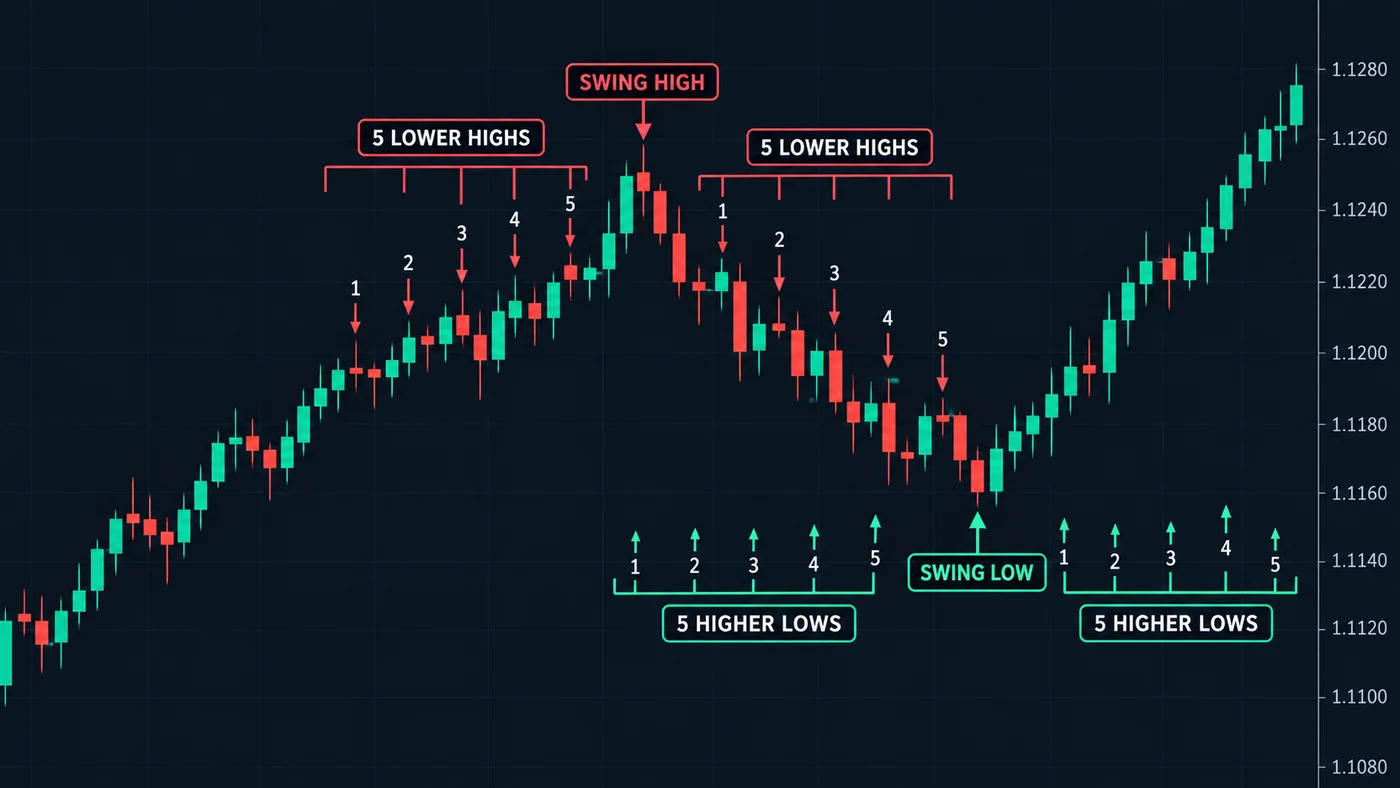
In one line: A swing high is a peak where price turned down, with lower prices on both sides; a swing low is a dip where price turned up.
A simple rule to spot them
A common, simple test: a swing high is a candle whose high is above the highs of the candles on both sides of it. A swing low is a candle whose low is below the lows on both sides.
Many traders want two candles on each side, so tiny wiggles don't count. We call these the last places price turned around, or turning points.
A simple example
Five daily candles have these highs: $10.20, $10.60, $11.10, $10.80, $10.40. The middle candle's high, $11.10, is above the two on each side. That's a swing high. Sellers took over there.
A few days later, five candles have lows of $10.10, $9.80, $9.55, $9.70, $9.90. The middle one, $9.55, is a swing low. Buyers stepped in there.
Why it matters
Swing points are the skeleton of the chart. Lined up, they show the Trend. Rising swing highs and lows mean an uptrend, falling ones a downtrend.
They're also where many traders put a Stop loss. For a buy, the stop goes just under the last swing low, because if price falls past it, the up pattern is broken. For a sell, just above the last swing high. See how to set a stop loss.
Our free StructureX chart tool marks these points automatically.
A common mistake
Marking every little wiggle. On a fast chart, there's a "swing" every few candles, and the picture turns to noise. Focus on the clear, obvious turns that stand out at a glance. If you have to squint, it probably doesn't matter.
The second mistake is calling a swing too early. A candle can't be a swing high until the candles after it have formed lower highs. Until then, it's just the latest high.
Questions
Are swing highs the same as resistance?
Related, but not the same. A swing high is one turning point. When price turns down at the same area several times, that area becomes Resistance.
How many candles do I need on each side?
Two on each side is a common choice. More makes the points bigger and fewer; less makes them smaller and more frequent.
Do swing highs and lows work on all timeframes?
Yes. A daily swing low matters more than a 5-minute one, because it shows a bigger turn.
Want the next step? We'll walk you through it.
Four free lessons by email, one every few days — each with a 10-minute exercise on a real chart.
Send Me the Free Lessons 4 short emails · No spam · Unsubscribe anytimeOr see the whole method, step by step:
See What’s Inside the Course Try everything free first. Decide when you're ready. · Open the free chart tool (works in the TradingView phone app)One chart idea a day, in plain English. Follow along: