
Backtesting vs forward testing: test on the past, then prove it live
A backtest asks, "Would my rules have worked on old charts?" A forward test asks, "Do they still work when I don't know what happens next?" You need both answers before real money is on the line.
The short answer
Backtesting means testing your rules on past price data. You step through old charts and record what your rules would have done. It's fast: you can test months in an afternoon.
Forward testing means testing the same rules in real time, as new bars form. Usually that's Paper trading first, then very small real size.
A backtest shows whether an idea is worth more time. A forward test shows whether you can follow it when the future is truly unknown.
Side by side
| Backtesting | Forward testing | |
|---|---|---|
| Data | Past charts | Live, new bars |
| Speed | Fast, many trades in hours | Slow, real time |
| Can you peek ahead? | Yes, the big trap | No, the future is hidden |
| Tests the rules | Yes | Yes |
| Tests you (nerves, patience) | Barely | Much more |
| Costs and fills | Often assumed | Closer to real |
| Main trap | Look-ahead and overfitting | Too few trades, quitting early |
| Comes | First | Second |
Backtesting, in plain words
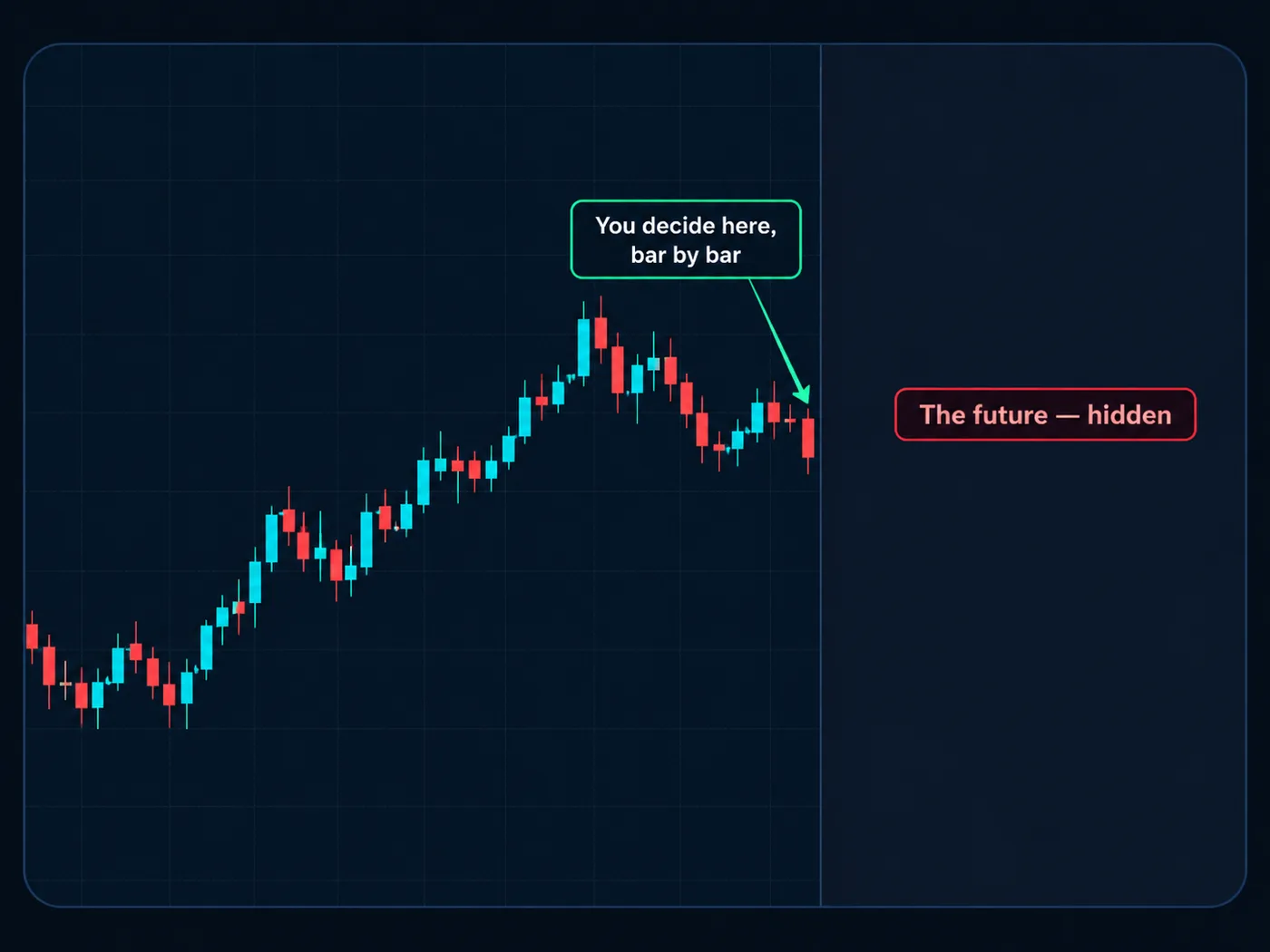
Pick a market and a Timeframe. Scroll back. Hide the future. Step forward bar by bar and take every trade your rules allow. Log each one.
On TradingView, the bar replay tool does this: it hides everything to the right and shows one new bar at a time. See TradingView bar replay.
The good parts:
- Lots of practice, fast. Many trades in one sitting.
- No money at risk.
- Finds broken ideas early. If a rule fails badly on old charts, you saved yourself a lot.
The limits:
- Look-ahead. If you can see what happened next, your "test" isn't a test. Never peek.
- Overfitting. Tweak the rules until they fit the past perfectly, and they often stop fitting the future.
- Easy fills. A backtest often assumes you got your price. Real fills can slip. See Slippage.
- No pressure. Losing on an old chart feels nothing like losing now.
Forward testing, in plain words
Same rules, but now the next bar really is unknown. You take trades as they set up, on paper or at very small size, and log them the same way.
The good parts:
- Honest. No way to peek.
- Real conditions. Spreads, news spikes and slow days all show up.
- Tests you. Will you take the setup after two losses? Will you skip a trade that isn't there?
The limits:
- Slow. It can take weeks to collect enough trades.
- Paper isn't real money. Feelings are still lighter than live. See paper trading vs live trading.
- Few trades can mislead. Ten trades say very little. Judge over many.
The look-ahead law. If you saw the outcome before you "took" the trade, it doesn't go in the log. One peeked trade quietly turns a test into a story.
The order we suggest
- Write the rules first. Entry, stop, target, size and a daily limit. See how to write a trading plan.
- Backtest about 100 trades on past charts with replay. Log every one, including losses and skipped trades.
- Read the results. Win rate, average win and loss in units of risk, the longest losing run. The expectancy calculator puts these together.
- Forward test on paper with the same rules. Keep logging.
- Compare. Are the forward results roughly in line with the backtest? If they're far worse, find out why before going further.
- Go live at small size. Size from the stop with the position size calculator.
Results in any test are hypothetical. Past results, real or tested, don't promise future ones. Losses are always possible.
Which fits you?
You don't choose one. You do them in order.
- Have a new idea? Backtest first. It's the cheapest filter.
- Have a backtest you like? Forward test before real money.
- Already trading live? Keep logging. Live trading is a forward test that never ends. See how to keep a trading journal.
Common mistakes
- Peeking during replay. The most common, and the most damaging.
- Changing the rules after every loss. That's fitting the past, not testing a plan.
- Testing 15 trades and calling it proven. Aim for many more.
- Trusting strategy-tester results blindly. Coded backtests can be fooled by look-ahead, unrealistic fills and costs left out. See Pine Script strategy backtest.
- Skipping the forward test. A great backtest that you can't follow live isn't much use.
Questions
What is the difference between backtesting and forward testing?
Backtesting tests your rules on past data, quickly. Forward testing tests the same rules in real time on new data, usually on paper or at small size first.
How many trades should I backtest?
More is better. Many traders aim for around 100 logged trades before judging a set of rules, because a small sample can mislead.
Is paper trading the same as forward testing?
Paper trading is the most common way to forward test. Trading live at very small size is another.
Why does my strategy work in the backtest but not live?
Common reasons are look-ahead (peeking), rules tweaked to fit the past, costs and slippage left out, or not following the rules under real pressure.
Want the next step? We'll walk you through it.
Four free lessons by email, one every few days — each with a 10-minute exercise on a real chart.
Send Me the Free Lessons 4 short emails · No spam · Unsubscribe anytimeOr see the whole method, step by step:
See What’s Inside the Course Try everything free first. Decide when you're ready. · Open the free chart tool (works in the TradingView phone app)One chart idea a day, in plain English. Follow along: