
BOS vs CHoCH: how to tell if a trend keeps going or turns
Both mean price broke past a turning point. The only question is which way, and that one detail tells you if the trend goes on or may be turning.
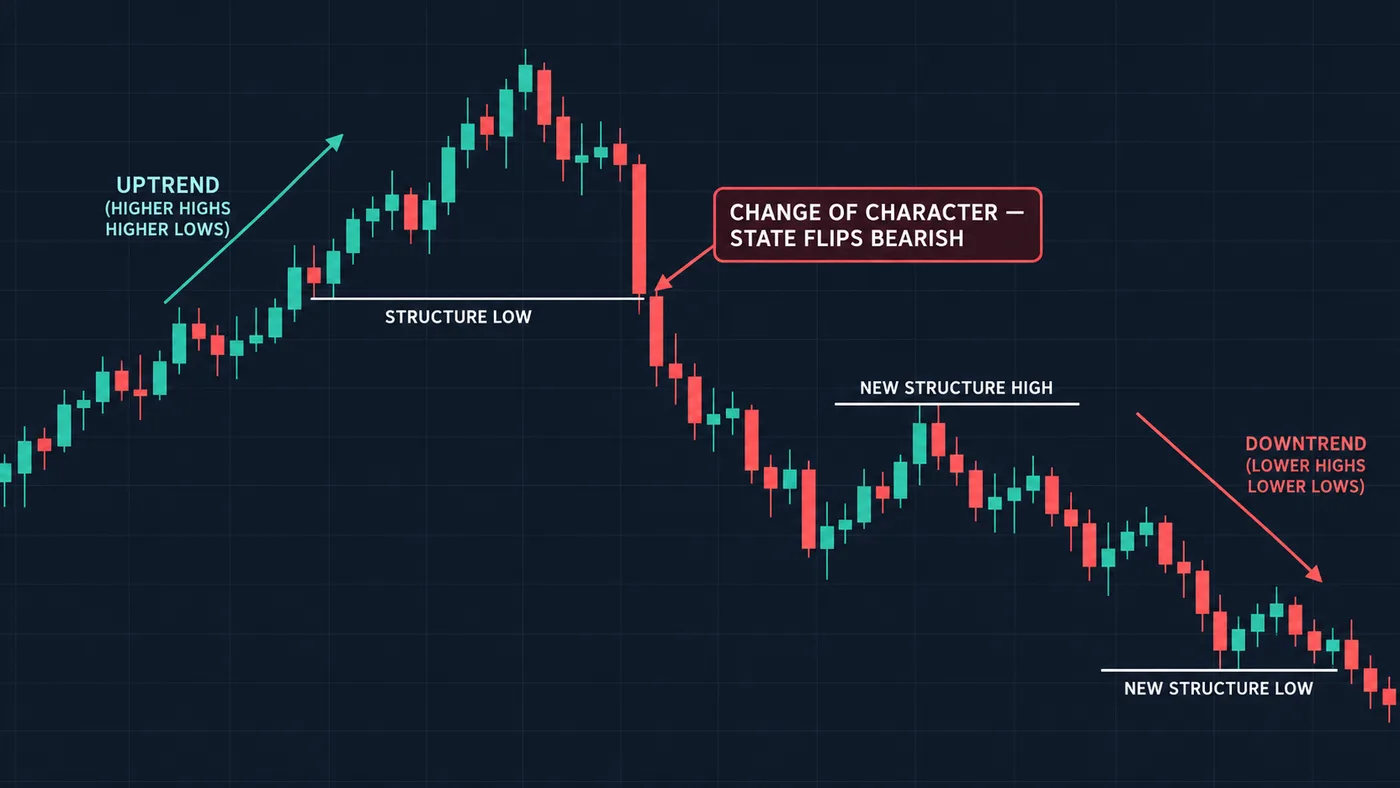
First, the turning points
Every chart has places where price turned around. A high is where it stopped rising and turned down. A low is where it stopped falling and turned up. Traders call these swing highs and swing lows. See Swing high and swing low.
An uptrend is a stair-step up: higher highs and higher lows. A downtrend is the reverse: lower highs and lower lows. More in higher highs and higher lows.
BOS and CHoCH are just names for what happens when price breaks one of those turning points.
The short answer
- Break of structure (BOS): price breaks a turning point in the direction of the trend. In an uptrend, it closes above the last high. Plain meaning: the trend keeps going.
- Change of character (CHoCH): price breaks a turning point against the trend. In an uptrend, it closes below the last higher low. Plain meaning: the trend may be turning.
Side by side
| Break of structure (BOS) | Change of character (CHoCH) | |
|---|---|---|
| Plain meaning | Trend keeps going | Trend may be turning |
| In an uptrend | Body closes above the last high | Body closes below the last higher low |
| In a downtrend | Body closes below the last low | Body closes above the last lower high |
| How often | Many times in a healthy trend | Once, near the end of a trend |
| What it tells you | Keep looking for trades with the trend | Stop trading the old trend, watch for a new one |
| Common trap | Chasing the break far from a level | Calling a reversal off a single wick |
The body-close rule
This is the one rule that keeps both terms honest: only a candle body closing past the level counts. Wicks don't.
A wick poking past a high and snapping back is often a trap, not a break. Price went to look, found no follow-through and came back. See breakout vs fakeout.
The test: wait for the candle to close. Is the body past the turning point? Yes means a break. Only the wick means not yet.
Break of structure: the trend keeps going
Picture an uptrend. Price makes a high, pulls back to a higher low, then pushes up again. A candle body closes above the last high. That's a break of structure.
What it means for you:
- The trend is still in charge. Look for the next pullback to trade in the same direction.
- The new higher low matters. It's the next level the trend must hold.
- Don't chase. The best spot is usually the pullback, not the candle that just broke out.
Change of character: the trend may be turning
Now the uptrend keeps going until one day price falls and a candle body closes below the last higher low. The stair-step is broken. That's a change of character.
What it means for you:
- Stop looking for buys in the old trend. The pattern that made it a trend is gone.
- It's a warning, not a promise. Price may chop sideways or even resume up. A new downtrend only shows itself when price makes a lower high and then breaks lower.
- Check the bigger chart. A change of character on a 5-minute chart means little if the daily trend is still strongly up. See multiple timeframe analysis.
Which matters more?
Both, for different jobs:
- Break of structure helps you stay with a trend and find the next trade.
- Change of character helps you stop trading a trend that may be ending.
Many traders wait for a change of character, then for the first break of structure in the new direction, before trading the new trend. That second step is the confirmation.
Our free chart tool on TradingView marks the turning points for you, so these breaks are easier to see. Add it here.
Common mistakes
- Counting wicks. A wick past a level is not a break. Wait for the body close.
- Picking tiny turning points. On a noisy chart every wiggle looks like a break. Use clear turns.
- Calling every change of character a reversal. It's the first warning. The trend may still continue.
- Ignoring the bigger chart. Small-chart breaks against a strong daily trend often fail.
Questions
What is the difference between BOS and CHoCH?
A break of structure breaks a turning point in the trend's direction, so the trend keeps going. A change of character breaks one against the trend, so the trend may be turning.
Does a wick count as a break of structure?
No. Only a candle body closing past the turning point counts. A wick that pokes through and snaps back is often a trap.
Is a change of character the same as a reversal?
Not yet. It's an early warning that the old trend may be ending. A new trend is usually confirmed when price breaks a turning point in the new direction.
Which timeframe should I use to spot BOS and CHoCH?
Start with the bigger chart, like the daily or 4-hour, to find the main trend. Then use a smaller chart to time entries in that direction.
Want the next step? We'll walk you through it.
Four free lessons by email, one every few days — each with a 10-minute exercise on a real chart.
Send Me the Free Lessons 4 short emails · No spam · Unsubscribe anytimeOr see the whole method, step by step:
See What’s Inside the Course Try everything free first. Decide when you're ready. · Open the free chart tool (works in the TradingView phone app)One chart idea a day, in plain English. Follow along: